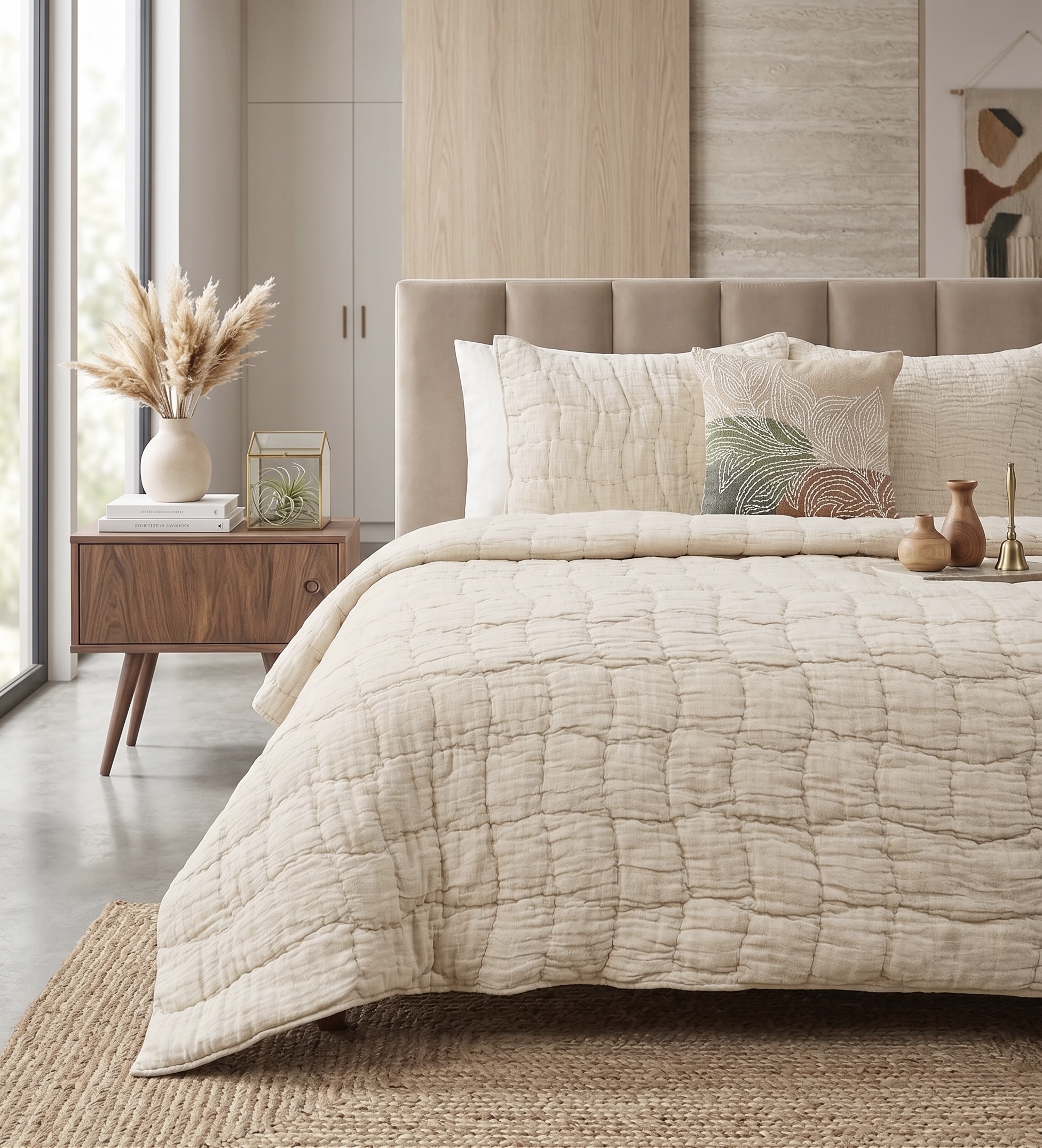
Wholesale quilts: how to source a private label range
By Abhijat Paliwal, founder, Abhi Home®, third-generation Indian home textile manufacturer (since 1965).
Most buyers who search for wholesale quilts want one of two things: finished quilts they can reorder quickly, or a factory that will make a quilt range under their brand. I have spent my working life on the second, and this guide is written from the factory side of that table. It covers the decisions that set the price and quality of a wholesale quilt program: construction, fill, stitching, size, US labeling and customs rules, certification, sampling, packing and how to compare quotes. At Abhi Home® we have made home textiles in India since 1965, and quilts are one of the constructions our bedding teams know best.
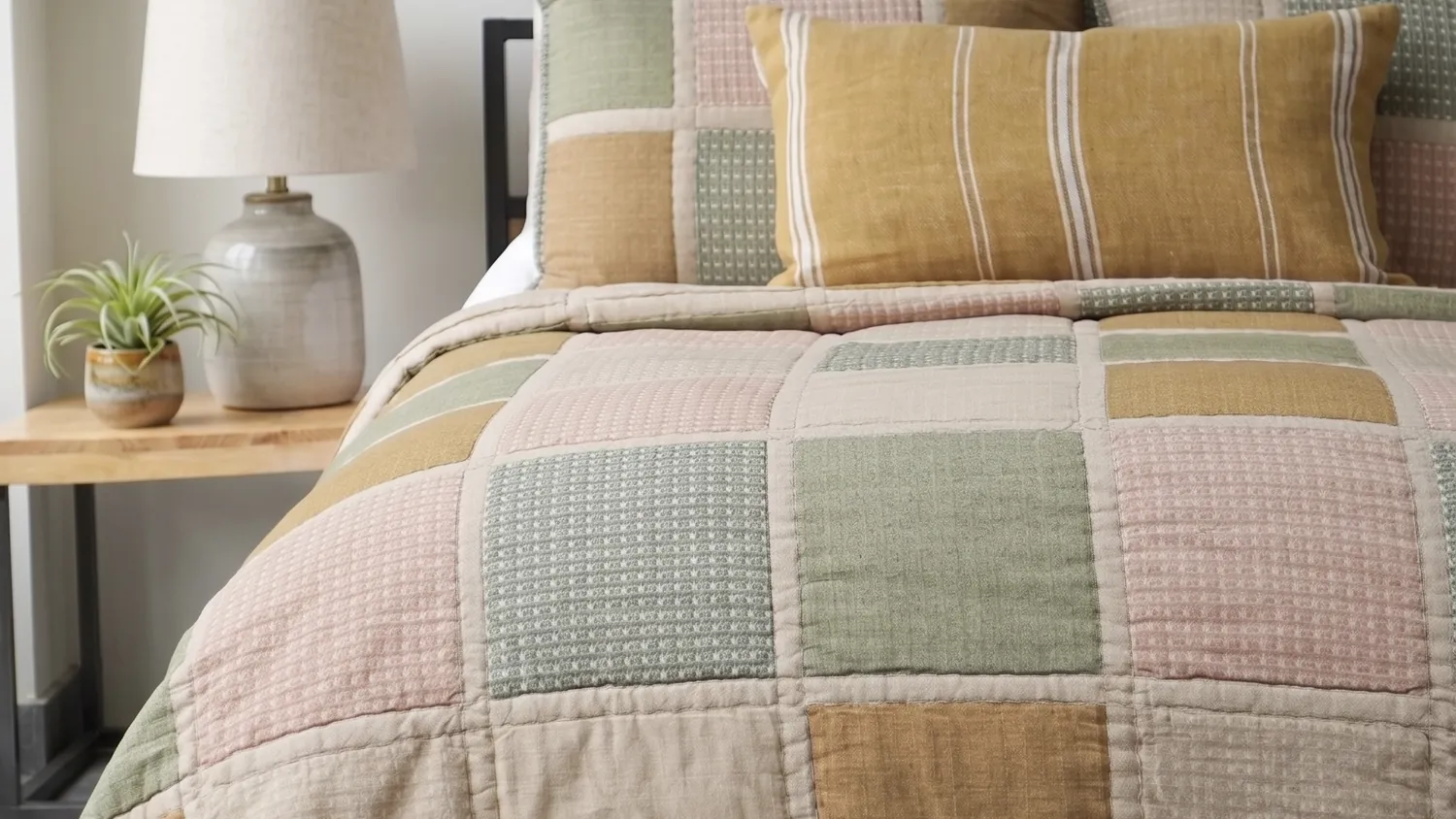
Patchwork quilt with a striped sham, made in India by Abhi Home®
One trim decision can change the duty on a quilt. In the US Harmonized Tariff Schedule, a plain cotton quilt enters under 9404.40.10 at a general duty rate of 4.4%. Add embroidery, lace, braid, edging, trimming, applique or piping wider than 6.35 mm, or use a man-made fiber shell, and it moves to 9404.40.90 at 12.8%, almost three times the rate, before any additional duties. I explain how to check the current rates in the customs section below.
What buying wholesale quilts really involves
"Wholesale quilts" covers two very different purchases. At one end is finished stock from a wholesaler: a design someone else owns, available to anyone who orders it, usually with another company's label and packaging already on it. At the other end is a private label program, where a manufacturer makes the quilt to your specification and ships it with your care label, your packaging and your barcode. Abhi Home® works only at the private label end, as an OEM manufacturer for retailers, importers, wholesalers and e-commerce brands.
Finished stock is quick and can suit a one-off promotion, but you control nothing: not the fabric, the fill, the size, or whether the same quilt turns up on a competitor's site next month. A private label program takes longer to set up, and every detail that decides quality and margin is written down and belongs to you.
The vocabulary matters before anyone quotes. A quilt is a construction: a face fabric, a filling and a backing, held together by stitching that runs through all three layers. A bedspread is a size idea, cut to hang down the sides of the bed. A coverlet is a lighter, smaller top layer. A comforter is a heavily filled quilt used on its own for warmth. Most of the quilts we make for US and European retail are lightly filled quilts or coverlets, often sold with matching shams. Our quilt and bedspread buying guide explains fills and stitching in more depth. This article is about running the purchase itself.
Three ways to start a private label quilt program
Inside a private label program there are three starting points. The one you choose decides how much development time you need and how exclusive the finished product is.
Route
What you get
Best for
Trade-off
Archive design in your colors
A proven quilt from our range, recolored and sized for you, under your label
Testing a new category or filling a gap in a season
The base design is not exclusive unless we agree it
Adapted design
An existing construction with changes: a new patchwork layout, border, quilting pattern or set contents
Retailers who want a signature look without starting from zero
Adds a sampling round
Fully custom
Your artwork, fabric, fill, quilting pattern and packaging
Brands with an in-house design team
Longest development and the most decisions to document
For a first order with a new factory, I usually suggest the first or second route, so you can judge the factory on a construction it already makes well. MOQs are flexible: they depend on construction and fabric, and we keep them lowest at sampling stage, so a small test order on one or two designs is a sensible way to begin. Our article on how MOQs really work explains what drives the minimum for each construction.
Quilt constructions and where each fits
Construction drives cost, repeatability and how the quilt sits on the shelf. These are the constructions we make, with the trade-offs I explain to buyers.
Patchwork
Pieced blocks of contrasting colors or textures, sewn into a single face before quilting. Patchwork tells a strong story in lifestyle retail and photographs well, as the quilt at the top of this article shows. The cost sits in cutting and piecing, so the number of distinct fabrics and the block size matter more than the quilting pattern. Ask for a block layout drawing with every fabric numbered. It is the only reliable way to check bulk against the approved sample.
Box and grid quilting
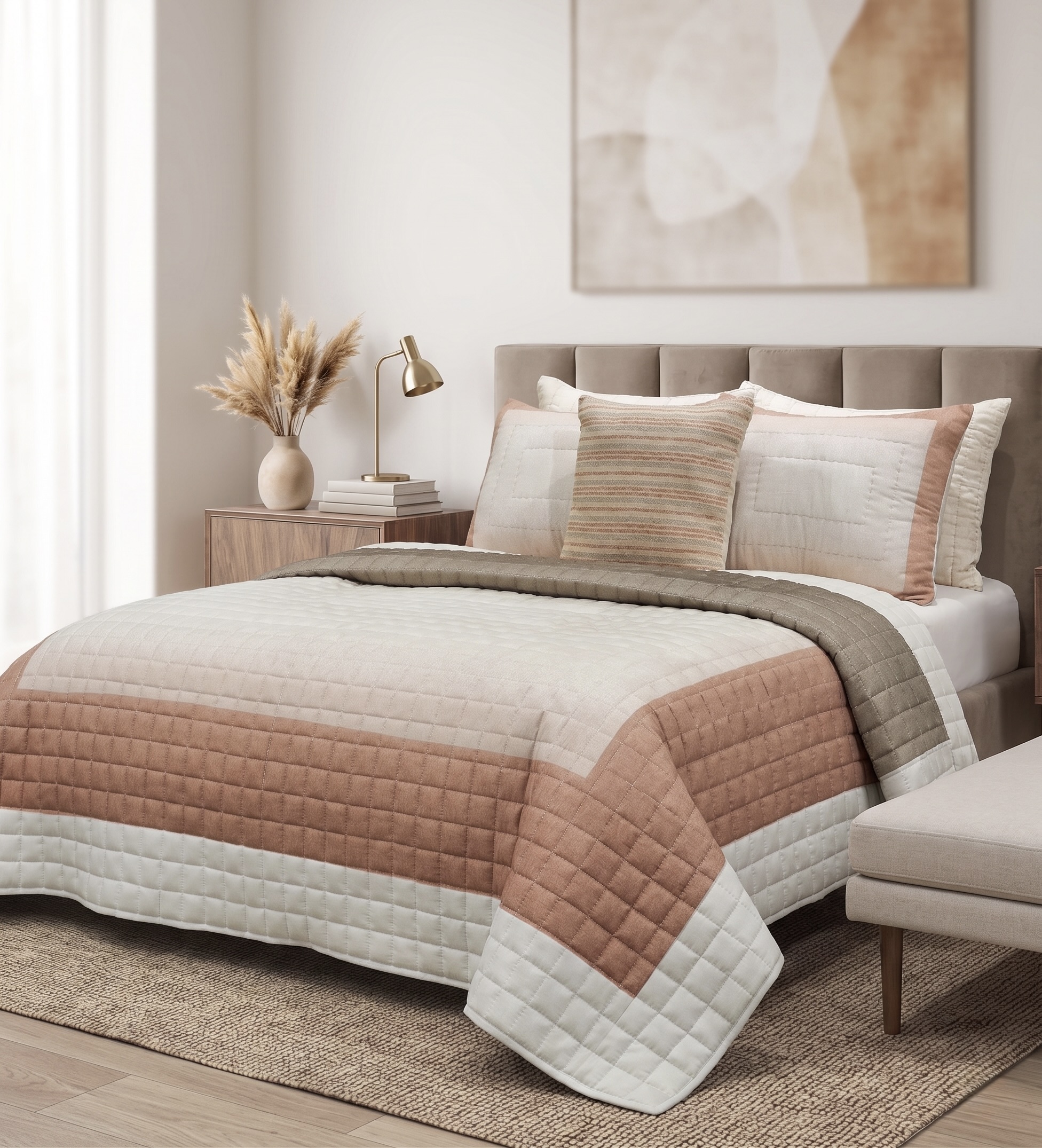
Straight-line quilting in squares or channels. It is clean, contemporary and quick to run, and it suits solids, stripes and washed cottons. Set the line spacing in the specification: wider spacing gives a softer, puffier look but lets the fill move, while closer spacing holds the fill firmly and reads flatter. The bedspread below shows box quilting across horizontal color bands.
Box and grid quilting on an ombré stripe bedspread (Abhi Home® style AH-QL-24-1211)
Engineered quilting
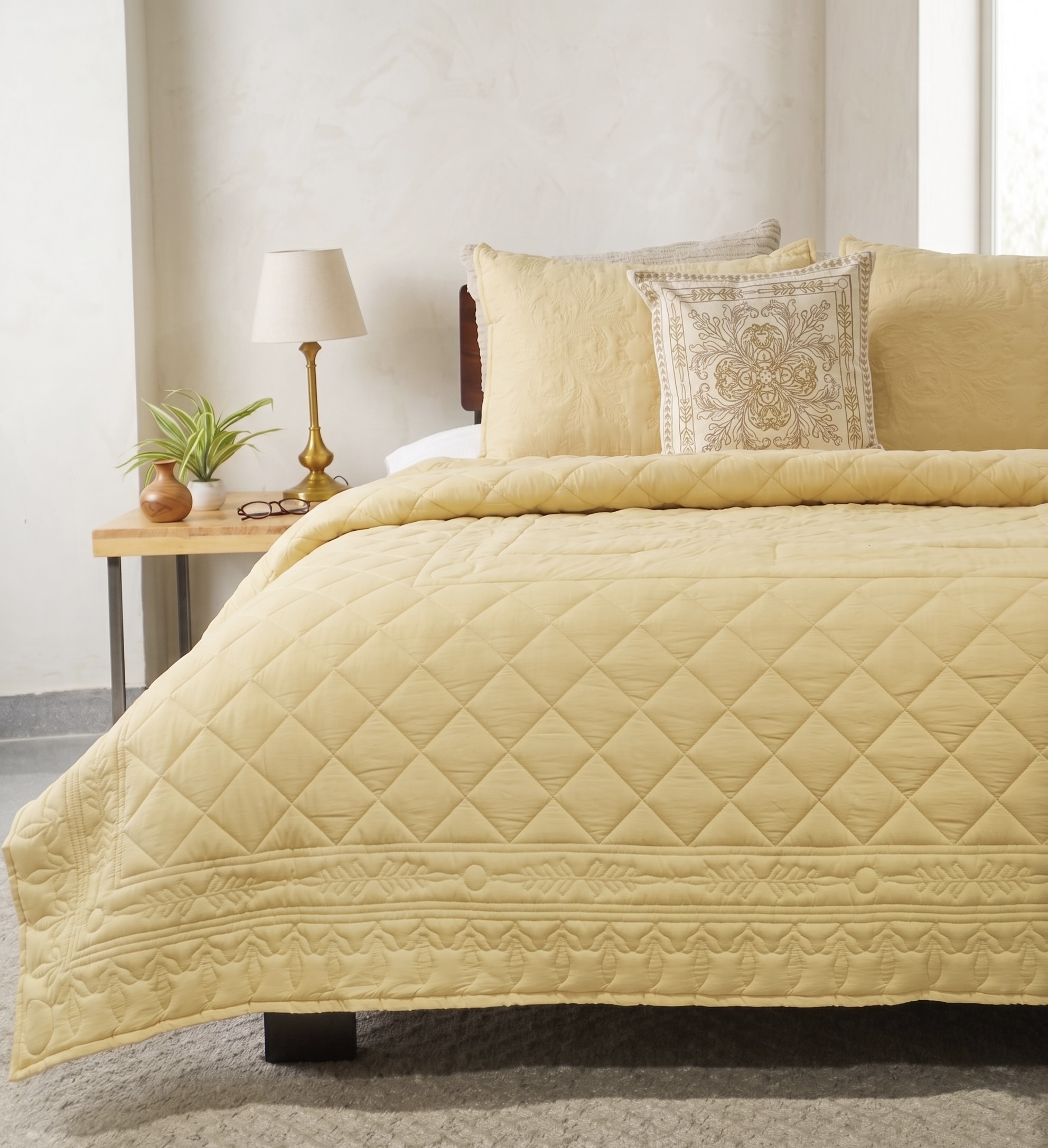
A machine-programmed pattern, such as diamonds or tonal florals, repeated identically across every piece. This is the construction I recommend when a retailer needs the hundredth quilt to look exactly like the first, because the pattern lives in the machine program rather than in someone's hand. It also allows a quilted border design without extra hand work, as on the marigold quilt below, which pairs diamond quilting in the field with a quilted floral border.
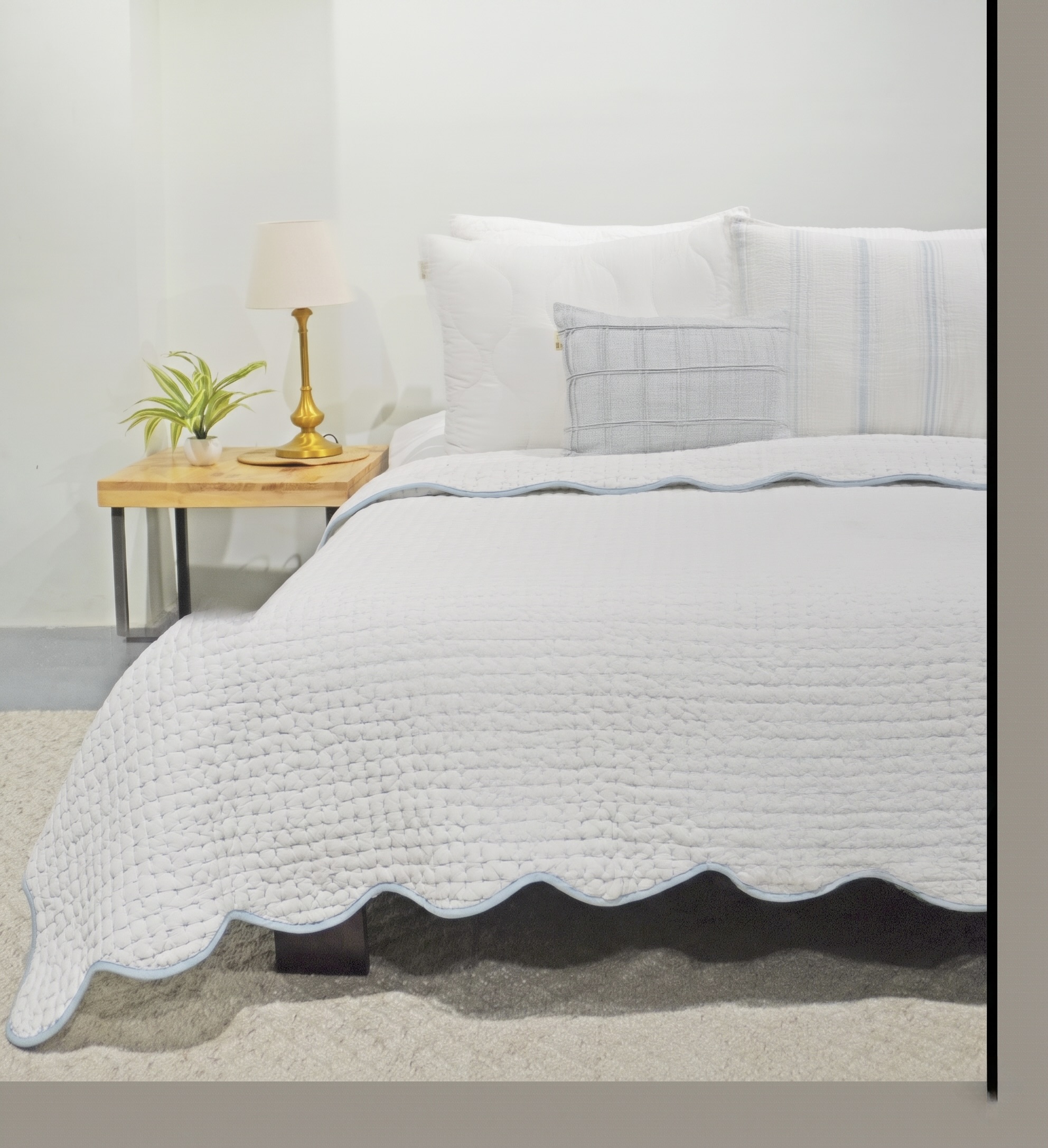
Kantha is the Indian running-stitch technique, worked by hand across the whole quilt. No two pieces are identical, and that slight variation is the point. Kantha quilts are made to order and priced by stitch density, so they suit hero pieces, boutique hotels and premium lifestyle retail rather than an opening price point. If you buy kantha, approve a tolerance for natural variation in writing, so that your QC team does not reject the very texture you paid for.
Hand kantha coverlet with a scalloped border (Abhi Home® style AH-QL-24-1226)
Velvet quilts
Velvet faces are quilted to hold their pile and sheen, and they are usually sold with matching velvet shams. Pile direction must run the same way across every panel and sham, otherwise the shade looks different from piece to piece. Velvet also marks if it is folded hard, so agree the packing method at sampling.
Crinkle and washed cotton
Garment-washed or crinkled cotton gives a soft, lived-in hand and a relaxed drape, and we offer it in organic cotton. Because the quilt is washed after making up, much of the shrinkage happens in the factory rather than in your customer's machine. The finished size therefore has to be measured and approved after washing, not before.
Crinkled organic cotton with box quilting (Abhi Home® style AH-QL-24-1222)
We run hand kantha and machine quilting under the same compliance scope, so a hand-stitched hero quilt and a repeatable engineered quilt can share one order and one container.
The specification that sets price and quality
Two quotes for "a queen patchwork quilt" can differ widely and both be honest, because they describe different quilts. A written specification makes quotes comparable and gives your QC team something to check bulk against. These are the lines I ask buyers to fill in.
Specification line
What to write
What goes wrong if it is missing
Face fabric
Fiber, weave, weight, and print or colorway references
A lighter cloth quietly replaces the one you saw
Backing
Fiber and weight, ideally close to the face
A thin backing puckers and wears through first
Fill
Fiber and fill weight in grams per square meter (GSM)
Loft and warmth change, because "light" means different things in different factories
Quilting
Pattern and maximum stitch spacing
Fill migrates and the quilt loses its shape after washing
Size and drop
Finished size with tolerance, and the drop you want
The quilt sits short on the bed, or is too heavy to use as a coverlet
Set contents
Quilt only, or with shams and cushion covers
Sets are quoted inconsistently between suppliers
Edge finish
Self binding, contrast binding, piping or scalloped edge, with widths
Binding wanders, and a wide piping can change the customs line (see below)
Wash performance
Shrinkage tolerance after an agreed wash, and color references
Size and squareness drift after the first wash
Labels and packing
Fiber and origin label, any state law label, care label, bag, insert card, carton marks
Goods are held or relabeled at your warehouse
In my experience, the quilts that come back from customers are rarely the ones in the wrong color. They are the ones where the fill had room to travel, or where nobody measured the finished size after a wash. If you are unsure what to write, send us a reference quilt you like and we will measure it and propose the numbers.
Sizing quilts for the US market
Bed names travel badly between markets, so start from the mattress rather than the label. These are the standard US mattress sizes that most quilt ranges are built around:
Bed size
Mattress (inches)
Note for quilt ranges
Twin
38 x 75
Often sold as one Twin/Twin XL size
Twin XL
38 x 80
Dorm rooms and older kids' rooms
Full
54 x 75
Often combined with Queen as Full/Queen
Queen
60 x 80
The core size for most ranges
King
76 x 80
Often combined with California King
California King
72 x 84
Longer and narrower than a King
To get a finished quilt size, add the drop to each side and to the foot of the bed. A worked example: a Queen coverlet for a 12-inch-deep mattress, with a 12-inch drop, comes to about 60 + 12 + 12 = 84 inches wide and 80 + 12 = 92 inches long, before any allowance for tucking at the pillow end. A bedspread that also covers the box spring needs a longer drop, and a coverlet layered over a duvet needs less. Mattress depth varies a lot, so check what your customers actually sleep on before you fix the drop. We also make oversized (OS) quilts for buyers who want a generous drape on deep mattresses.
Many US quilt programs combine sizes, Full/Queen as one SKU and King/California King as another, which keeps the size run short and reorders simple. Shams usually come in standard (20 x 26 in) and king (20 x 36 in). To lift the basket, add a sham or a coordinating cushion cover rather than a fourth quilt size.
US labeling, customs and safety rules for imported quilts
None of these rules is difficult, but each needs to be agreed with your factory before the sample is approved, because labels and trims are made along with the goods. I am a manufacturer, not a lawyer, so treat this as a checklist to confirm with your compliance team and customs broker.
Fiber content, origin and dealer identity
The Federal Trade Commission's guide to labeling requirements under the Textile and Wool Acts lists bedding, including comforters, quilts and bedspreads, among covered products. The label must show fiber content, country of origin and the identity of the manufacturer or another responsible business, either by name or by RN. Filling used for warmth must have its fiber disclosed, which is why quilt labels usually read in sections, such as covering and filling. Our quilts are labeled made in India.
Care labels work differently: the FTC's Care Labeling Rule is written for textile wearing apparel and certain piece goods, so it does not require one on a quilt. We still recommend one, written to match the wash test the approved sample passed.
California law labels for filled bedding
California's furniture and bedding law defines "bedding" to include quilts, comforters, pillows and cushions that are or can be stuffed or filled (Business and Professions Code section 19007, in the Bureau of Household Goods and Services law book). The bureau states that every article of bedding must carry a law label, and that businesses must be licensed before they operate. If your filled quilts will be sold in California, settle the licensing and the law label text with your compliance team before production. Check, too, whether any other states you sell into have their own rules for filled articles.
Customs classification
In the US Harmonized Tariff Schedule, subheading 9404.40 covers quilts, bedspreads, eiderdowns and duvets (comforters). Within it, 9404.40.10 is for cotton quilts that do not contain any embroidery, lace, braid, edging, trimming, piping exceeding 6.35 mm or applique work, and other quilts, including those with a man-made fiber shell, fall under 9404.40.90. In other words, a design decision such as a wide piping, an embroidered border or an applique motif can move a quilt to a different line. Check the current wording and duty rate on the USITC Harmonized Tariff Schedule and confirm the classification with your broker before you cost the range, because rates change.
Quilts for children
A quilt designed or intended primarily for children 12 or younger is a children's product. The Consumer Product Safety Commission's children's products guidance says these must undergo third-party testing and have a written Children's Product Certificate. The same guidance notes that most home furnishings are not treated as children's products unless they have features such as childish themes, child sizing or marketing aimed at children. The CPSC's third-party testing page also states that, beginning July 8, 2026, importers of most regulated consumer products must eFile certificates with US Customs and Border Protection, so ask your broker how that applies to your range.
Certifications and the documents to ask for
OEKO-TEX STANDARD 100 is our standard for bedding, including quilts. GOTS certified organic cotton is available on request, and GRS recycled options suit buyers with recycled-content targets, for example a recycled polyester fill. Abhi Home® holds BCI, GOTS, OEKO-TEX and GRS certifications, and our quality management system is certified to ISO 9001:2015.
A certificate is only useful if it covers your product. Check that it names the site that makes your quilts and the product scope you need. You can check an OEKO-TEX label number through OEKO-TEX STANDARD 100, and a GOTS certificate through the Global Organic Textile Standard website. If you plan to print an organic or recycled claim on your packaging, ask for transaction certificates for each shipment, because the claim needs a document trail from fiber to finished quilt. Our article on OEKO-TEX, GOTS and GRS explains what each one proves.
From brief to bulk: how a quilt program runs
Every program with us follows the same path, and each step is written down, so there are no surprises when the cartons arrive.
Brief. You send target sizes, quantities, price point, design direction or archive references, and your destination market.
Construction options. We come back with constructions, fabrics and fill weights that fit the price point, and we tell you where a cheaper option is likely to cost you later in returns.
Color and print approvals. Lab dips for solid colors and strike-offs for prints, approved against your color standards. Our guide to lab dips, strike-offs and PP samples explains each stage.
First sample. Made against the written specification and numbered. Judge it on a bed rather than a table, then wash it and measure all four sides.
Pre-production sample. Made from bulk fabric with final labels and packaging. Once approved, it becomes the reference for bulk.
Bulk production. Updates at agreed stages, and a final inspection by you or your agent before shipment.
Shipping and documents. Goods ship on the agreed basis with the commercial invoice, packing list, certificates and any test reports you asked for.
Timing depends on the construction and on how quickly approvals come back. Hand-worked quilts take longer than machine-quilted ones, so in a mixed range I plan the kantha pieces first. Our guide to private label home textile development walks through the full process.
Packing and shipping quilts
Quilts are bulky, so the fold, the bag and the carton decide both how a quilt looks on the shelf and how many fit in a container. Settle these points at the pre-production sample:
Fold size. Match it to your shelf depth or e-commerce box.
Bag. A polybag for e-commerce, a clear zip bag with an insert card for store shelves, or a fabric bag with a handle for gifting.
Insert card and barcode. Printed with your branding, with the barcode format your system reads.
Carton. Units per carton, carton marks and a weight your warehouse team can handle.
Compression. A tighter pack saves freight space, but it can leave fold lines in velvet and flatten crinkled cotton. Agree it on a sample before bulk.
Then agree the shipping basis: FOB, CIF or DDP, and the destination port or warehouse. If you are unsure which suits you, our guide to FOB vs CIF vs DDP sets out the trade-offs, and our packaging and labeling guide covers what to specify on each carton.
How to compare wholesale quilt quotes
Two quotes are only comparable when they describe the same quilt delivered on the same terms. Before you look at the unit price, line the quotes up against these checks:
Check
What to ask
Why it matters
Construction
Patchwork, box, engineered, kantha or velvet, and whether it is made in-house
Similar photos can hide very different amounts of work
Fill
Fiber and fill weight in GSM
A lighter fill is the easiest way to make a quote look cheaper
Size
Finished size after washing, with tolerance
A smaller quilt costs less and disappoints on the bed
Trims
Piping, embroidery, applique, scalloped edges
Trims add cost and can change the customs line
Labels
Fiber and origin label, any law label, care label
Relabeling at your warehouse costs time and money
Packaging
Bag, insert card, barcode, carton
Packaging can change the landed cost noticeably
Certification
Certificates naming the production site and product scope
Any claim you print must be backed by documents
Shipping basis
FOB, CIF or DDP
Freight and duty decide the real landed cost
Compare landed cost, not unit price. A quote that is lower because the fill is lighter, the quilt is smaller or the packaging is extra is not a lower price.
Frequently asked questions
What is the minimum order for wholesale quilts?
At Abhi Home® MOQs are flexible and depend on the construction and fabric. We keep them lowest at sampling stage, and hand kantha quilts are made to order. Share your target quantities and sizes and request a quote against your specification.
Can you make quilts under my brand?
Yes. Abhi Home® is an OEM and private label manufacturer only. Every quilt program runs under the buyer's brand, with your care label, your packaging and your barcode, made to your tech pack.
Which quilt construction is best for a first order?
For a first order, box or engineered quilting is the safest choice, because the pattern repeats identically and is easy to check against the sample. Add a hand kantha or patchwork piece as a hero design once you are confident in the factory.
What labels does an imported quilt need in the US?
Under the FTC's Textile Act guidance, the label shows fiber content (including any filling used for warmth), country of origin and the responsible business. Filled quilts sold in California also need a law label. The FTC Care Labeling Rule does not require a care label on quilts, but we recommend one.
Are your quilts certified?
OEKO-TEX STANDARD 100 is our standard for bedding, including quilts. GOTS certified organic cotton is available on request, and GRS recycled options are available for buyers with recycled-content targets.
Start a quilt program with Abhi Home®
If you are planning a quilt range for next season, the most useful first step is a short brief: target sizes, quantities, price point, two or three design references and your destination market. Request our bedding catalogue or send a program brief, and we will come back with construction options and samples. You can also browse our current quilt designs, the full bedding collection with coverlets and comforters, and our guide to bedding manufacturing in India.
Planning a private label quilt range?
Send us your sizes, constructions, quantities and destination, and we will come back with construction options and samples.