The best wholesale bath mat supplier is the one whose factory actually matches your program: the right fiber, construction, backing, compliance paperwork and packing for your market. A low quote from the wrong kind of factory costs more in the end. In this guide I set out what separates a good supplier from a risky one, how Abhi Home® approaches bath mat and bath rug programs, and the checks I would make before committing to any bulk order.
How to choose the best wholesale bath mat supplier
What makes a good wholesale bath mat supplier
After six decades in home textiles, my view is simple: a good supplier is predictable. The sample you approve is the product you receive, the paperwork matches the goods, and problems are raised early rather than discovered at your warehouse. In practice, that comes down to a handful of things you can check before you place an order.
- It makes what you are buying. Ask which constructions are made in-house and which are bought in. A factory that tufts and weaves cotton bath mats every day will hold a specification better than one that sources them from elsewhere.
- Its certificates cover your product. A certificate should name the site that makes your goods and the product scope you need, not just the company name on a website.
- It samples properly. Expect a written specification, a numbered sample and clear feedback on what can and cannot be changed before bulk.
- It tests what matters for your market. For the US that includes flammability for small rugs and correct fiber and origin labeling, both covered below.
- It can pack for your channel. Retail packaging, barcodes and carton marks are part of the product, not an afterthought.
- It tells you the trade-offs. A supplier who explains why a backing or weight will or will not work for your price point is usually one who will also tell you about a problem in production.
Where Abhi Home® fits
Abhi Home® is a third-generation home textile manufacturer in India, established in 1965. We make cotton bath mats and bath rugs for retailers, importers and brands, always as OEM / private label production under the buyer's brand. The bath range is the core of what we do today, and you can see it on our Cotton Bath Mat & Bath Rug Manufacturer India | Abhi Home® page.
What we make for bath programs:
- Constructions: tufted cotton bath mats, woven bath mats, reversible mats, 100% cotton chenille bath rugs, crochet-edged mats and kids' shaped bath mats.
- Anti-slip backings for single-sided mats: latex, spray latex, hot melt and TPR rubber, chosen to suit the market and the price point.
- Formats: single mats, bath rug sets (rug and contour, rug, contour and lid cover, two rugs in two sizes, or rug and runner), plus bath runners and large bath rugs in custom sizes.
- Fiber options: conventional cotton, or any design produced in certified organic cotton to order.
On paperwork, we hold BCI, GOTS, OEKO-TEX and GRS certifications and ISO 9001:2015 quality management certification, and we ship to buyers in 22 countries. MOQs are flexible, which helps when you want to test a new colorway or shape before scaling it across stores. If you are still shaping the range, our guide on how to specify a cotton bath mat program walks through the decisions in order.
A new bath program with us usually follows the same path. You send a brief, and we come back with the constructions, weights and backings that fit your price point and market, including where we think a cheaper option will cost you later. We make a numbered sample against a written specification, and once you approve it, that sample and specification become the reference for bulk production. During production we share updates at agreed stages, and we welcome a pre-shipment inspection by you or your agent. Nothing about this is unusual; the point is that every step is written down, so there are no surprises when the cartons arrive.
Cotton bath mat constructions and backings explained
Most disagreements between buyers and factories start with a word that meant different things to each side. "Tufted" and "woven" are the two that cause the most trouble, so it is worth being precise in your brief.
Tufted bath mats are made by punching cotton yarn through a base fabric to form loops or cut pile. They are plush and soft underfoot and take raised patterns well, such as cobblestones, stripes and carved designs. A tufted mat can be made single-sided, with an anti-skid backing on the underside, or reversible, with two usable faces. On a single-sided mat the backing does real work: it holds the pile, adds grip and affects how the mat behaves in the wash.
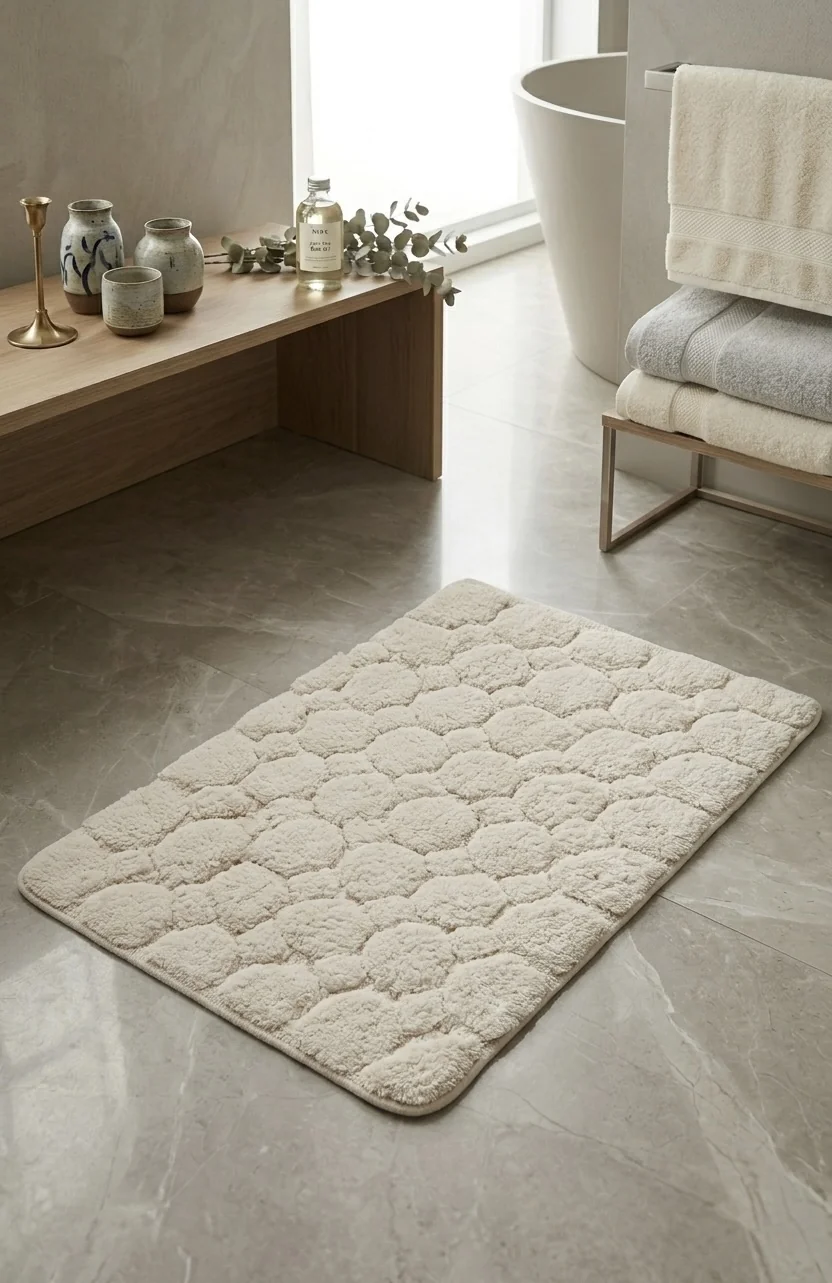
Woven bath mats are made in one piece on the loom, so the texture is part of the structure rather than a pile on top. They are normally single-sided, with an anti-skid treatment on the underside, and they usually dry faster and shed less than a plush tufted mat. Two mats can look alike in a photo and still be different constructions, which is exactly why your brief should name the construction and your sample approval should confirm it.
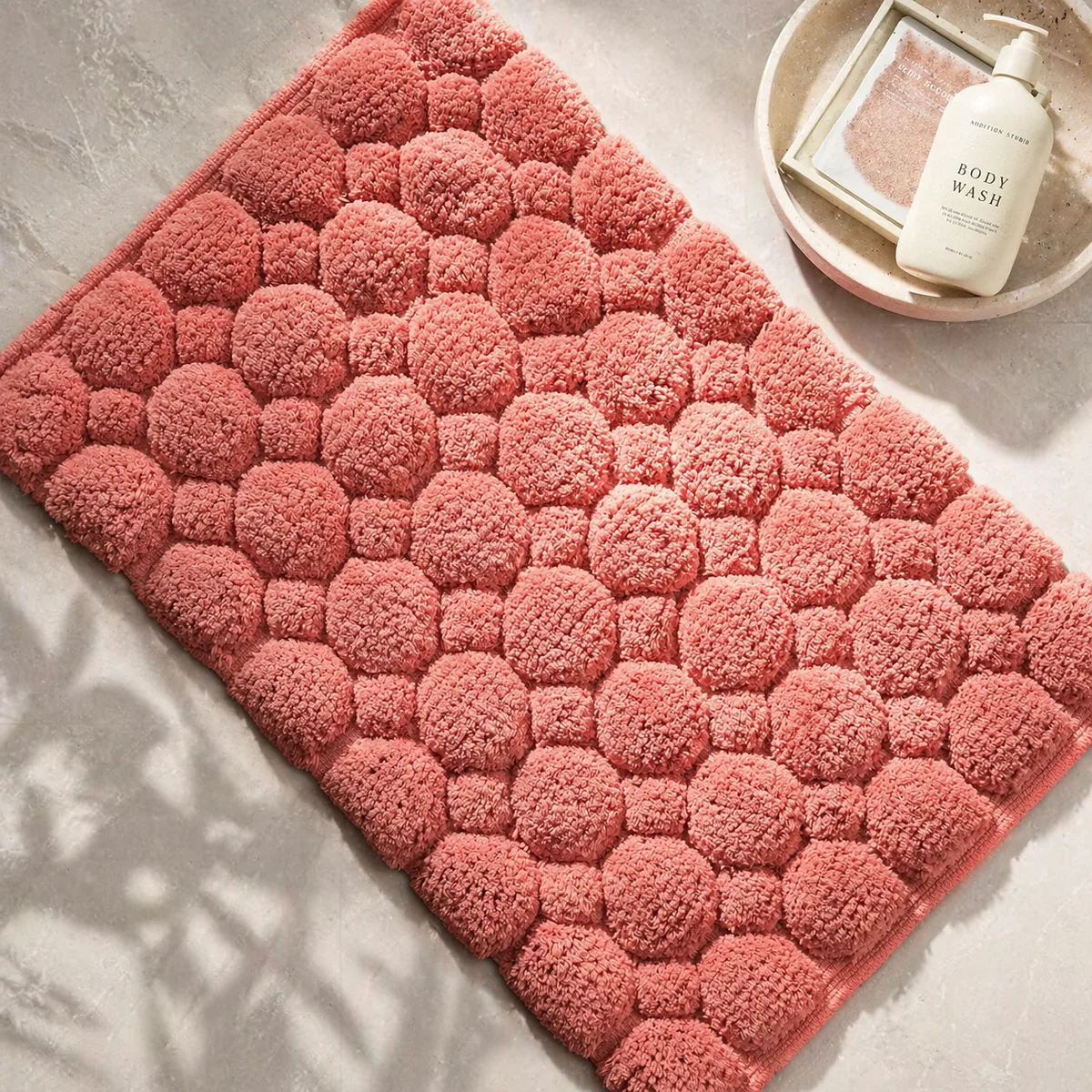
Chenille bath rugs use a soft, velvety chenille yarn; ours are 100% cotton chenille. Reversible mats have two usable faces, and tufting is the easiest way to make one. Because both sides are used, a reversible mat cannot take an anti-skid treatment. It suits buyers who want an all-cotton mat with two usable sides; if your market needs a non-slip mat, choose a single-sided one instead.
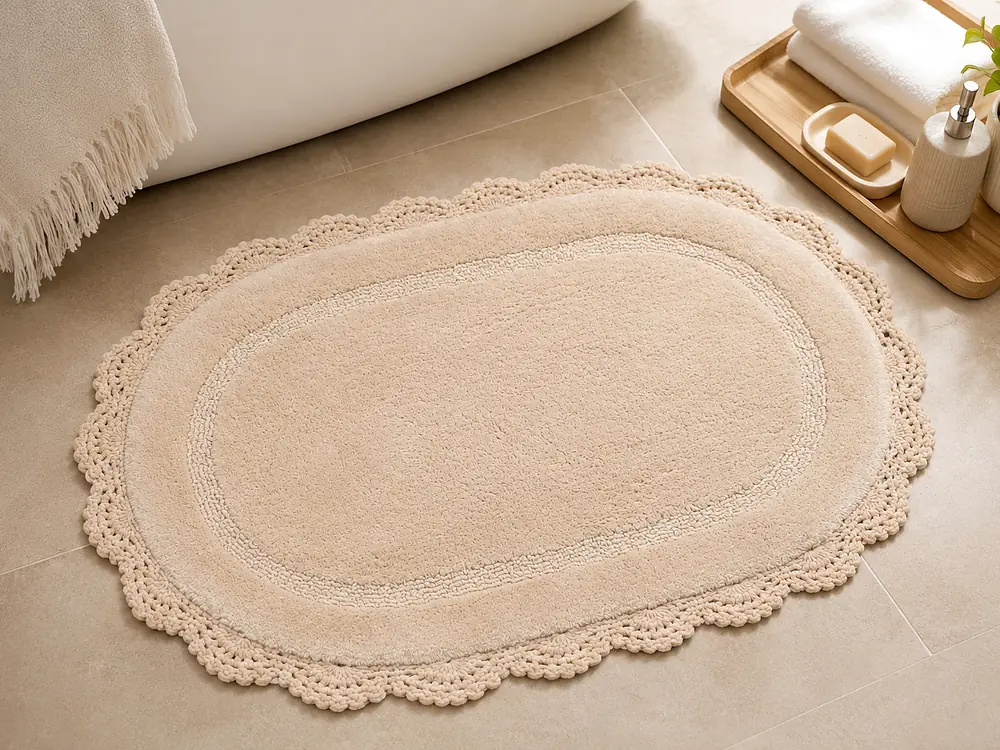
Crochet-edged mats add a hand-crocheted border to a cotton ground and sell well as a decorative upgrade. The rug below is one of ours: a cotton pile center finished with a hand-crocheted scalloped border.
For single-sided mats, tufted or woven, the anti-skid backing is the other big decision. Latex and spray latex are the most common choices; hot melt and TPR rubber are the alternatives, each with its own feel, grip and cost. They also behave differently with heat, so match the backing to the care label you plan to print, and test the finished mat through the wash cycle your customers will actually use. Our guide to bath mat constructions goes into more detail.
If you are building a coordinated bath range, decide early how closely the pieces must match. A mat, a contour and a lid cover cut from the same dye lot will match; pieces dyed separately can drift by a shade, which shoppers notice when the set sits together on a shelf. For runners and large bath rugs made to custom sizes, ask how the backing is applied across long lengths and how the edges are finished, because a long rug puts more strain on both than a standard mat does.
US rules to check before you import bath mats
For the US market, three sets of rules come up on almost every bath mat program. None of them is difficult, but each needs to be agreed with the factory before production, not discovered at the port.
- Flammability of small rugs. Bath mats and small rugs fall under the federal surface flammability standard for small carpets and rugs, 16 CFR Part 1631. It covers rugs with no dimension greater than 6 feet and an area of no more than 24 square feet. A small rug that does not meet the standard must carry a permanent warning label, so ask your supplier how each construction and backing has been tested.
- Fiber content and origin labeling. The Federal Trade Commission's guide to labeling requirements under the Textile and Wool Acts explains how fiber content, country of origin and the identity of the manufacturer or dealer must appear. The guide also confirms that rug backings are excluded from the fiber content disclosure, so the percentages describe the face of the mat. Agree the exact label text, and who supplies it, at the sampling stage.
- Cotton claims. If you plan to market a mat as "100% cotton", the FTC's guidance on labeling and advertising cotton products is worth reading, especially for blended yarns and backings.
Certification claims need the same care. If your range will be sold as organic, check the factory's certificate on the Global Organic Textile Standard website, and for tested-for-harmful-substances claims, check the label number against OEKO-TEX STANDARD 100. A certificate must cover the product and the site that makes it, not just the company name. Our article on OEKO-TEX, GOTS and GRS explains what each one proves.
What to put in a wholesale bath mat brief
A clear brief is the cheapest quality control you will ever buy. When every supplier quotes against the same document, the quotes become comparable and the sample approval becomes a real check. This is what I ask buyers to send us:
- Size and shape: each size in the set, including any contour, lid cover or runner, with tolerances.
- Construction: tufted, woven, chenille or crochet-edged, single-sided or reversible, and loop or cut pile where relevant.
- Fiber and certification: conventional or organic cotton, recycled content, and which certificates must appear on the documents.
- Weight target: pile weight or GSM range, because it drives both hand feel and cost.
- Backing: for a single-sided mat, latex, spray latex, hot melt or TPR rubber and the grip performance you expect. A reversible mat has no anti-skid backing.
- Colors: color standard references and how many colorways per design.
- Care and labels: the wash and dry instructions you want printed, plus fiber content and origin text.
- Packaging: header card, belly band, polybag or box, barcode format and carton marks.
- Shipping basis: FOB, CIF or DDP, and the destination port or warehouse. If you are unsure which to choose, our guide to FOB vs CIF vs DDP explains the trade-offs.
Then ask the supplier to confirm, in writing, the sampling steps, the order quantity and timing for your exact specification, payment milestones and how defects are handled. Our post on bath mat MOQs, lead times and sampling covers what to expect at each stage.
How to compare supplier quotes
Two quotes are only comparable when they describe the same mat delivered on the same terms. Before you look at the unit price, line the quotes up against these checks:
| Check | What to ask | Why it matters |
|---|---|---|
| Construction | Tufted, woven, reversible or chenille, made in-house or bought in | Similar photos can hide different constructions and quality levels |
| Weight and size | Pile weight or GSM and finished size with tolerances | A lighter or smaller mat can make a quote look cheaper |
| Backing | Single-sided or reversible, and for single-sided mats the backing type and how it is tested in the wash | Backing drives grip, durability and care instructions |
| Certification | Certificates naming the production site and product scope | Claims you print must be backed by the right documents |
| Packaging | Retail pack, barcodes and carton marks included or extra | Packaging can change the landed cost noticeably |
| Shipping basis | FOB, CIF or DDP, and who handles each step | Freight and duties decide the real landed cost |
Wholesale pricing depends on material, construction, size, order volume, branding and packing. Compare the unit cost alongside freight, duties where applicable, and the cost of any custom setup. A lower unit quote may not be the lower landed cost. If your sourcing team handles these conversations over video calls, structured negotiation practice, such as the remote programs from Edge Negotiation Group, can help keep the discussion on total terms rather than unit price alone.
Pro tip
Keep the approved sample and the signed specification together. Use them as the reference point for production checks and any later quality review.
Warning signs when shortlisting a supplier
Most sourcing problems announce themselves early if you know where to look. These are the signals that make me cautious when I see them on the other side of the table, and they apply whichever country your supplier is in:
- Certificates that do not name the production site. A certificate issued to a different company or unit does not cover your goods.
- No written specification. If the supplier is happy to proceed on photos alone, there is nothing to hold the bulk order against.
- Vague construction terms. "Soft cotton mat" is not a specification. Construction, weight, size and backing should all be stated.
- Samples that cannot be traced. Ask where the sample was made. A sample from one unit and bulk from another is a common cause of rejected shipments.
- Resistance to inspection. A supplier confident in its production welcomes a pre-shipment inspection by you or your agent.
- Prices well below the rest of your quotes without an explanation. The difference usually shows up later as lighter weight, a cheaper backing or missing paperwork.
Frequently asked questions
What should I look for in a wholesale bath mat supplier?
Start with a supplier that makes the construction you need in-house. Then check sample quality, backing, care instructions, certifications that name the production site, and written order terms. For a private label program, approve the packaging and branding details before production begins.
Is a tufted bath mat better than a woven one?
Neither is better in general. Tufted mats feel plusher, take raised patterns well and can be made single-sided with an anti-skid backing or reversible with two usable faces. Woven mats are made in one piece, usually dry faster and are normally single-sided with an anti-skid backing. Choose by the feel and care routine your customers expect, and name the construction in your brief so the sample and bulk order match.
Do bath mats need flammability testing for the US?
Yes. Bath mats and other small rugs fall under 16 CFR Part 1631, the federal standard for the surface flammability of small carpets and rugs. Ask your supplier how each construction and backing meets it, and agree any required labeling before production.
How do I compare wholesale bath mat quotes?
Send each supplier the same written specification. Compare unit price with order quantity, construction, weight, backing, packaging, payment terms and shipping basis. A quote is only comparable when the product details and delivery terms match.
Can Abhi Home® make bath mats under my brand?
Yes. Abhi Home® makes cotton bath mats and bath rugs to your specification as OEM / private label production under your brand. We hold BCI, GOTS, OEKO-TEX and GRS certifications and work with flexible MOQs. Send us your brief and we will come back with sampling options.
Send your bath mat brief
If you are building a private label bath mat or bath rug range, the quickest way to a useful quote is a short brief: sizes, construction, backing, colors, packaging and destination. Request our catalogue or send a program brief, and we will come back with sampling options. You can also browse the full bath mat and bath rug range first.
Building a private label bath mat range?
Send us your sizes, construction, backing and destination, and we will come back with sampling options.
Send your brief →