Hotel bath mats look like the simplest line on a housekeeping order and behave like one of the hardest. A mat in a guest bathroom takes wet feet from a different person every night, goes through a commercial wash far more often than any mat in a home, and has to look the same in the last room on the corridor as in the first. I am Abhijat Paliwal, and at Abhi Home® we have made home textiles in India since 1965. We make cotton bath mats and bath rugs as OEM and private label programs under the buyer's brand, and hospitality briefs are a regular part of that work. This guide covers the decisions that matter when you buy bath mats for hotels: which construction survives your laundry, how backing and slip risk trade off, sizes and weights, US compliance, sampling, and how to set the program up so every reorder matches.
Bath mats for hotels: how to specify and source them
What a hotel needs from a bath mat
Before construction or color, write down the job. In a hotel, a bath mat faces four demands that a retail mat rarely faces together.
- Laundering. The mat is washed between guests or on a fixed housekeeping schedule, by an on-premise laundry or an outside linen contractor. The wash temperature, chemistry and dryer heat are set by the laundry, not by the care label.
- Wet floors. It sits on tile or stone beside a tub or shower, where the floor is wettest and guests are barefoot.
- Consistency. Every room should look the same, and next year's reorder has to match the mats already in service.
- Replacement. Mats are retired as they wear, stain or go missing, so the program runs as repeat orders against a fixed specification.
A retail bath mat is designed to win on the shelf and is washed at home a few times a month. A hotel mat is designed to survive a laundry that will never be gentle with it. Everything else in this guide follows from that.
Why hotels choose rug-style bath mats
The bath mats we make for hotels are rug-style: a tufted, woven or chenille mat that stays on the floor as part of the room's design, which many US buyers call a bath rug. Hotels use them in suites, boutique properties, spas, serviced apartments and extended-stay rooms. A rug-style bath mat gives the bathroom a finished look and something warmer underfoot, and it can carry the room's color scheme. In return it asks more of the specification, because it is heavier, it may carry a backing, and it has to come through commercial laundering looking like itself.
Which construction suits hotel use
Four constructions from our bath range come up on hotel briefs. They behave very differently in a commercial laundry, so this is the decision to get right first.
Reversible bath mats (no backing)
A reversible bath mat has two usable faces and no backing at all. Tufting is the easiest way to make one: the pile is finished on both sides, so housekeeping can turn the mat between washes and spread the wear across two faces. For hotels, the missing backing is the attraction. Standard latex has a temperature ceiling, and a latex-backed mat laundered industrially degrades quickly; a reversible mat has nothing to crack or peel in a hot wash or dryer. The trade-off is grip. A reversible mat cannot take any anti-skid backing or treatment, because both faces are used, so it relies on the floor finish and on where it is placed. If your properties need a non-slip mat, choose a single-sided construction.
Woven bath mats
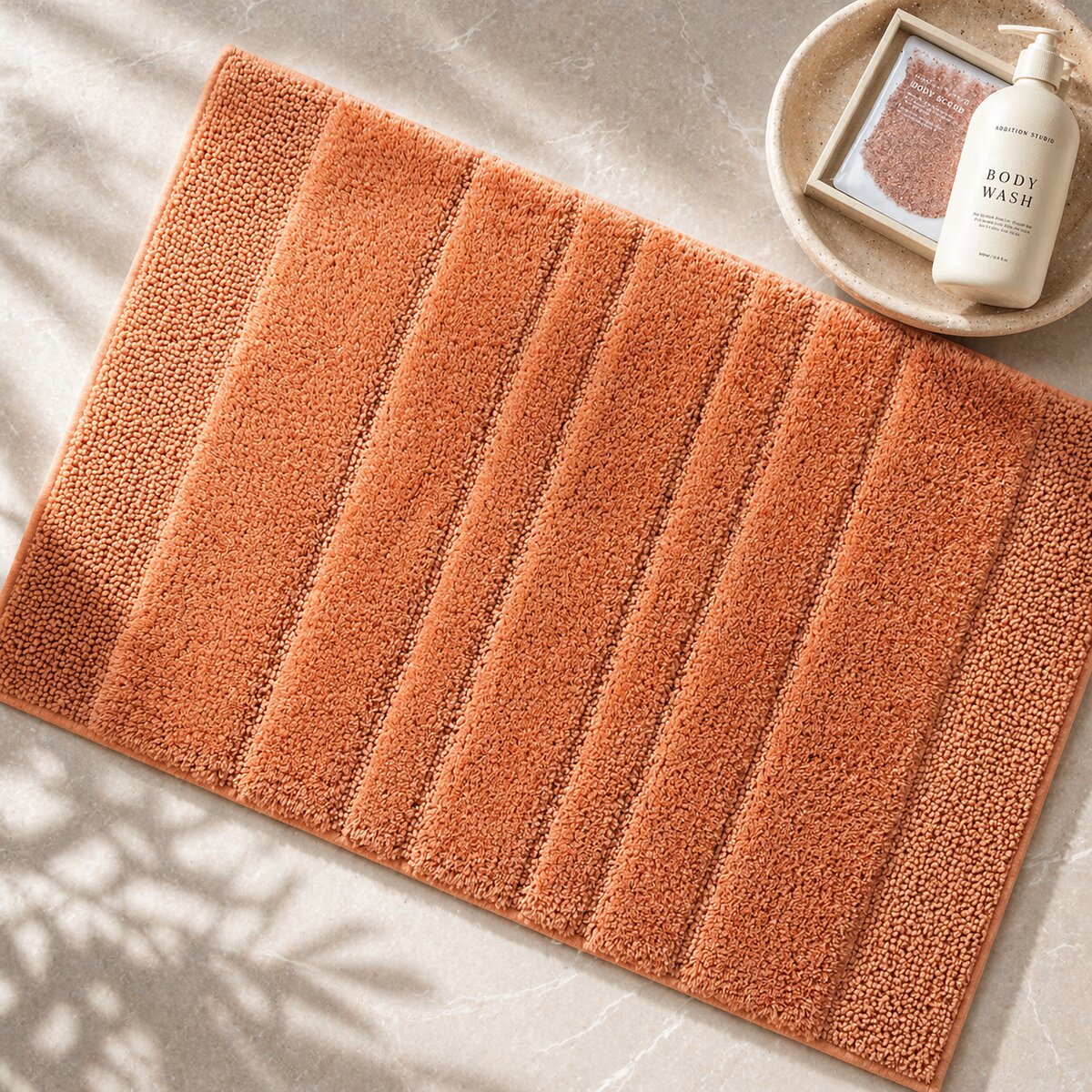
A woven bath mat is made in one piece on the loom. The pebble, bubble or ribbed relief is part of the cloth itself, with no pile punched into a backing cloth, so there is nothing to shed and the texture cannot pull out in the wash. It also dries faster than a deep pile because the relief lets air through. That is why woven is usually our first suggestion for high-turnover rooms, serviced apartments and extended stay. Woven mats are normally single-sided, with non-slip latex backing as standard on our relief constructions and latex-free or TPR rubber options. What woven gives up is plushness: a relief will never feel as deep underfoot as a heavy tufted pile.
Single-sided tufted bath mats
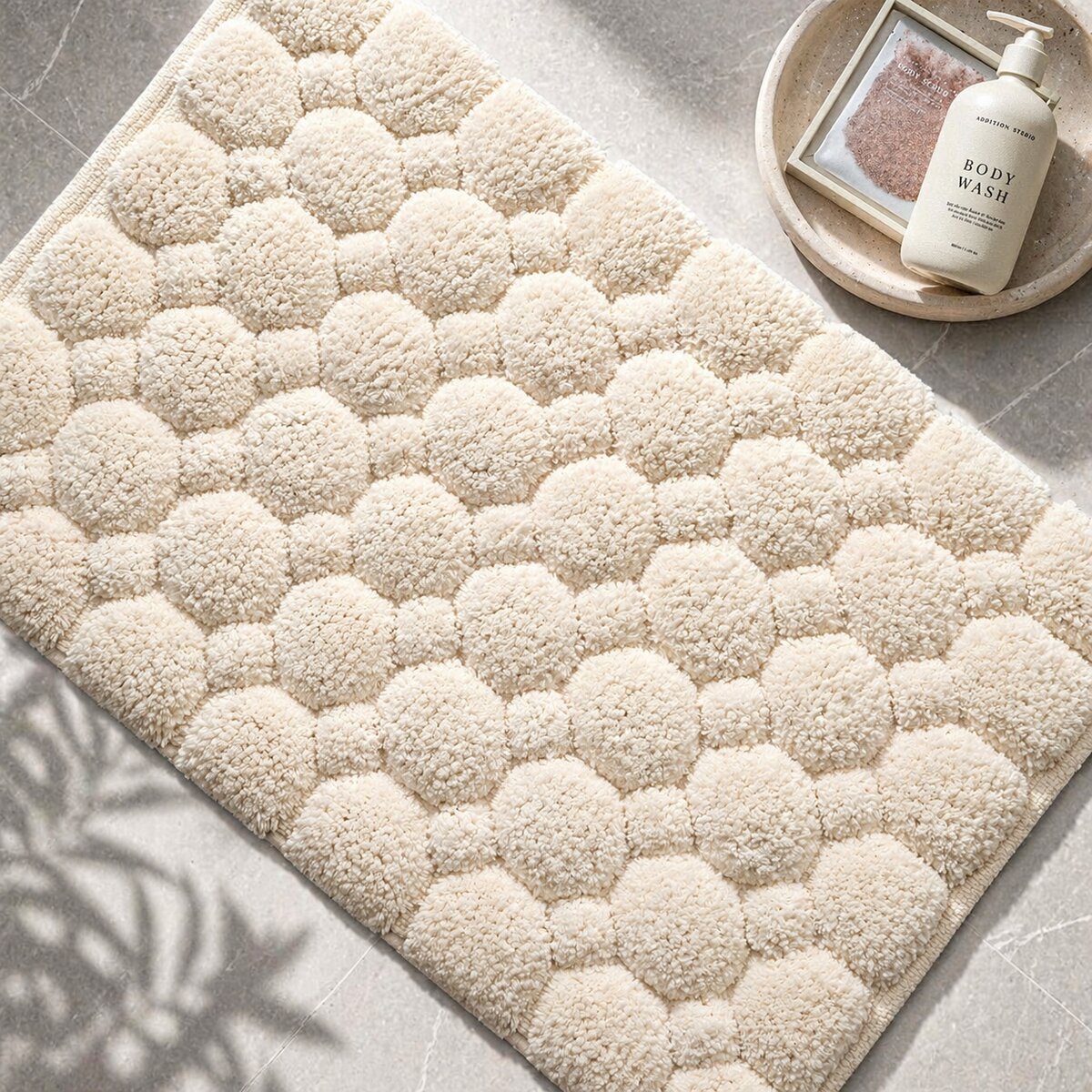
Tufting punches yarn through a base cloth to build a pile, and on a single-sided mat a backing locks the tufts in place and grips the floor. This is the plush end of the range: cut and loop, carved and high-low tufted cotton bath mats that give a suite real depth underfoot, with the pattern carried by the pile rather than by print. The backing decides how long it lasts in a hotel. We offer latex, spray latex, hot melt and TPR rubber. Standard latex suits 30 to 40°C home washing and low or line drying, not hot tumble drying. TPR is generally more flexible than latex and more durable through repeated machine washing, so it is the usual pick for mats washed often. Whichever you choose, prove it in a wash test at your laundry's real settings.
Chenille bath rugs
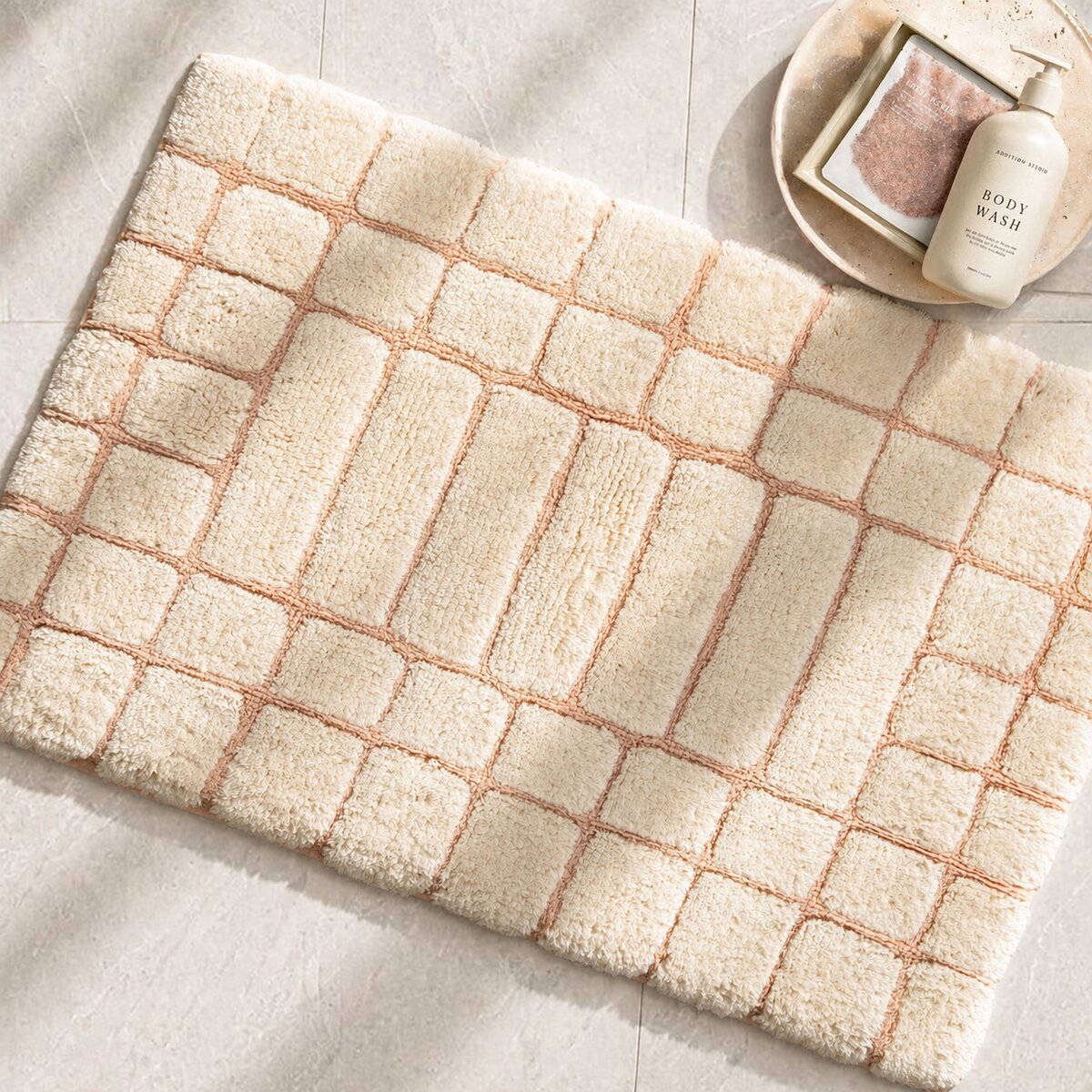
Chenille is a yarn before it is a rug: short lengths of pile twisted between two core yarns, building a deep, rounded surface that is softer than a standard cut pile. We make chenille bath rugs in 100% cotton for suites and spa rooms where the bath rug is part of the guest experience. Yarn quality decides whether chenille keeps its pile through washing, so pile security is checked on the sample and again after a wash test. Chenille takes the same backing choices as tufted, and the same laundry caution applies.
| Construction | Backing | Commercial laundering | Grip on wet tile | Where it fits |
|---|---|---|---|---|
| Reversible (tufted) | None, by design | Strongest fit: no backing to fail | None from the mat itself | Rooms on a hot laundry program, spas |
| Woven relief | Latex standard; latex-free or TPR | Good: nothing to shed; check the backing | Good when backed and tested wet | High-turnover rooms, extended stay |
| Single-sided tufted | Latex, spray latex, hot melt or TPR | Depends on the backing | Good when backed and tested wet | Suites and boutique rooms |
| Chenille (100% cotton) | Latex standard; other backings or unbacked | Depends on backing and pile security | Good when backed and tested wet | Suites and spa bathrooms |
Start with your laundry, not the design
The most useful document you can send with a hotel bath mat brief is your laundry's wash program. Ask your on-premise laundry or linen contractor for four facts: the wash temperature and how long the hot stage lasts, the chemistry (bleach, alkali, sour), the dryer temperature, and how often each mat goes through.
Commercial cycles vary a great deal. The CDC's healthcare guidance on laundry and bedding notes that a temperature of at least 160°F (71°C) for a minimum of 25 minutes is commonly recommended for hot-water washing, and it also describes lower-temperature cycles that rely on chemicals. Hotels are not bound by that guidance, but it shows how far a commercial hot cycle can sit from the 30 to 40°C home wash that standard latex backing is made for. Bleach matters too: colored mats fade faster than white or ivory under chlorine, so ask before you choose a color.
Here is how that plays out on a typical brief. Say you want an ivory mat at 22 x 34 inches, laundered by a contractor on a hot cycle and tumble dried, with grip on porcelain tile. The last two requirements pull against each other. If the laundry cannot run a cooler program for mats, the cleanest answer is a reversible tufted mat, accepting that grip comes from placement. If grip is non-negotiable, we would sample a single-sided woven or tufted mat with TPR backing and ask your laundry to run the samples through their real cycle before anyone approves bulk. What we will not do is put standard latex on a mat headed for a hot industrial program and hope.
For a published reference point, ISO 15797 sets out industrial washing and finishing procedures for testing textiles intended to be industrially laundered. It was written for workwear, so treat it as a starting point with your test lab; a test on your own laundry's cycle usually tells you more.
Slip risk and the backing decision
Slip risk is the line your operations and risk teams will read most closely. The CDC's study of nonfatal bathroom injuries estimated that 234,094 people aged 15 and over were treated in US emergency departments for bathroom injuries in 2008, that 81.1% of those injuries were caused by falls, and that about two thirds happened in the tub or shower. Those figures cover all bathrooms, mostly at home, but they show where the risk sits: on wet floors around bathing.
A single-sided mat with a backing that grips is the conventional answer. A mat that slides on wet tile, or a backing gone brittle after hot washes, adds risk. Three points from the factory side:
- Test grip wet and after washing. A backing that grips on a dry desk can behave very differently on wet porcelain after repeated laundry cycles. Check samples in both states, on the floor finish your properties use.
- Do not claim what has not been tested. If grip has not been tested by a lab, keep "non-slip" off your specification sheet and anything guests see. Ask your lab which method suits your floors.
- Match the care instructions to the backing. A care label that allows a hot wash on a latex-backed mat sets the backing up to fail.
Reversible mats have no backing, so they carry no grip claim. That is a legitimate choice for many hotel bathrooms, but it should be a deliberate one, agreed with whoever owns guest safety at your properties.
Sizes, weights and colors for a hotel program
Our running sizes are 50 x 80 cm and 60 x 90 cm (about 20 x 31 and 24 x 35 inches), with 45 x 70, 55 x 85 and 70 x 120 cm on request, plus contour and pedestal mats. Many US hotel specifications are written in inches, such as 20 x 30 or 22 x 34, and we make custom dimensions for hospitality contracts. For double vanities and large bathrooms, our bath runners and large bath rugs are cut to the room, specified once and repeated across properties.
Weight is the number that best predicts how a mat feels and behaves in the laundry. Our tufted pile weights typically run from 1,200 to 2,200 GSM depending on construction and price point, and we quote hospitality contract weights separately. Heavier is not automatically better for a hotel: a heavy pile holds more water, dries slower, adds weight to every laundry load and is harder for housekeeping to handle. For fast room turns, a lighter tufted weight or a woven relief often serves better.
Most hotel programs run white, ivory or a neutral that matches the bathroom. The detail that matters is repeatability: approve a color standard at sampling and make every reorder against it, so next year's mats sit beside the ones in service without a visible shift. For a monogram or motif, we work custom patterns to your artwork, tufted into the pile or embroidered on a flat-woven mat, and confirm the detail at sampling.
Certifications and US compliance
Abhi Home® holds BCI, GOTS, OEKO-TEX and GRS certifications, and OEKO-TEX® Standard 100 is our default for bath programs. OEKO-TEX® STANDARD 100 is a label for textiles tested for harmful substances, which matters for a product guests stand on barefoot. Organic cotton under GOTS and recycled content under GRS are both available for sustainability commitments, but standard latex backing is not GOTS-compliant, so an organic claim and a non-slip back need to be discussed together. Our explainer on OEKO-TEX, GOTS and GRS sets out what each one proves.
For the US market, three rules come up on bath mat orders:
- Flammability. The federal surface flammability standard for small carpets and rugs, 16 CFR Part 1631, covers rugs with no dimension greater than 6 feet and an area of no more than 24 square feet, and states that mats within those dimensions are included. A small rug that fails must be permanently labeled as flammable, so agree the test plan with your lab before bulk.
- Labeling. The FTC's guide to labeling requirements under the Textile and Wool Acts sets out what a textile label shows: fiber content, country of origin and the identity of the manufacturer or another responsible business. Our mats are labeled made in India.
- Tariff classification. Tufted floor coverings sit under heading 5703 and woven ones under heading 5702 of the USITC Harmonized Tariff Schedule, so the construction you choose changes the tariff line and the duty rate. Confirm the line for your construction with your customs broker.
Our buyer's checklist for importing bath rugs from India covers the documents that travel with the order.
Sampling and wash testing before bulk
A hotel sample has to prove more than a retail one, so write the sampling plan first. If you want to build a cotton mat specification line by line, our program guide covers pile height, GSM, yarn, backing and edge finish. For hotel work, I add these steps:
- Brief with the laundry program attached. Construction, size, color standard, weight target, backing, edge finish, and your laundry's wash and dry settings.
- Counter-sample and lab dip. We sample against your target and send physical samples at our cost. Approve color in daylight against your standard, not on a screen.
- Wash test at your laundry. Run samples through your real program for a number of cycles agreed with your laundry partner, then check shrinkage, color change, shedding, the edge binding and, on single-sided mats, whether the backing is still bonded and still grips.
- Approve a sealed sample. The approved sample, with written measurements and wash results, becomes the standard bulk is inspected against.
- Pre-production and inspection. Confirm a pre-production sample from bulk yarn, then inspect bulk against the sealed sample before shipment. Our article on quality control in a home textile factory explains where these checks sit.
Setting up the program: packing, reorders and terms
Hotel bath mats are a repeat-order business, so set the program up for the second order as well as the first.
- Plan quantities from your par. If housekeeping plans bath linen in pars, plan rug-style mats the same way and add an allowance for wear and loss. That gives a realistic annual volume to quote against. We work to flexible MOQs, so a first order for one property can grow into a group program.
- Pack for the receiving dock, not the shelf. Agree folding or rolling, pieces per carton and carton marks, including property codes if deliveries are split. Our guide to packaging and labeling for export has the full list.
- Fix the specification for reorders. Keep the sealed sample, color standard and tech pack on file at both ends, so a reorder is a purchase order against an approved standard, not a new development.
- Agree terms early. FOB, CIF or DDP, payment terms and delivery windows per property. Our comparison of FOB, CIF and DDP explains who pays for what. US hotel groups can also contract through Abhi Home Inc., our US trading entity, with goods shipped direct from India.
Much of this gets agreed on video calls across time zones. If your procurement team negotiates supplier terms remotely, Edge Negotiation Group has a useful piece on negotiation training for remote teams.
What to ask a bath mat manufacturer
The questions that separate a factory that understands hotel work from one that does not are mostly about laundering. Our guide to choosing the best wholesale bath mat suppliers sets out the full checklist. For hotel programs, add these:
- Did they ask about your laundry program before they quoted?
- Will they support a wash test on your cycle before bulk?
- Which backings can they offer, and what wash temperature suits each one?
- Can they supply certificates and transaction certificates that name the product and production site?
- Can they repeat the same color standard and weight on a reorder, and how do they record it?
At Abhi Home® we make bath mats and bath rugs as OEM and private label production only, under the buyer's brand. US buyers can see what we make for their market on our bath textile page for the United States.
Frequently asked questions
What size bath mats do hotels use?
It depends on the bathroom, but many US hotel specifications use 20 x 30 or 22 x 34 inches. Our running sizes are 50 x 80 cm and 60 x 90 cm, and we make custom dimensions for hospitality contracts, including runners for double vanities.
Can a hotel bath mat have a non-slip backing and still go through commercial laundry?
Yes, if the backing is chosen for the laundry program. Standard latex suits 30 to 40°C home washing, not hot industrial cycles or hot tumble drying. TPR rubber is generally more durable through repeated washing. Either way, wash test samples on your laundry's real cycle.
Are reversible bath mats a good choice for hotels?
They are a strong choice where the laundry runs hot, because there is no backing to crack or peel and both faces can be used. The trade-off is that a reversible mat cannot take any anti-skid backing.
Do hotel bath mats need flammability testing in the US?
Generally yes. 16 CFR Part 1631 covers small carpets and rugs with no dimension over 6 feet and no more than 24 square feet, and mats within those limits are included. Confirm the test plan with your lab.
What is the minimum order for hotel bath mats?
At Abhi Home® MOQs are flexible and depend on the construction, size and number of colors. Share your annual volumes and request a quote against your specification.
Start a hotel bath mat program
If you are specifying bath mats for one property or a group, send us the room sizes, the look you want, your laundry's wash program and rough annual quantities. We will suggest the constructions that fit, send samples you can put through your own laundry, and come back with a quote against the specification you approve. Request our catalogue or send a program brief, or browse the full bath mat and bath rug range.
Specifying bath mats for your hotels?
Send us your room sizes, construction, laundry program and destination, and we will come back with sampling options.
Send your brief →