A comforter set is often the hero of a bedding floor. It is the largest piece on the bed, the one shoppers see first in a photograph, and the one that decides whether the matching shams, cushions and coverlets sell with it. That is why wholesale comforter sets need a tighter specification than most buyers expect. I am Abhijat Paliwal, and at Abhi Home® we have made home textiles in India since 1965. We make comforters and comforter sets as OEM / private label production under the buyer's brand. This guide covers what a retailer, importer or hospitality buyer should define, test and ask before placing a wholesale comforter set order.
Wholesale comforter sets: a private label buying guide
What a wholesale comforter set includes
There is no single industry definition of a comforter set, so the first job is to write down exactly what goes in the bag. The most common format is a comforter with one or two matching shams. Some programs add a bed skirt, decorative cushions or a coordinating coverlet. Others sell a "bed in a bag" with sheets as well.
Each extra piece changes the fabric yield, the packaging, the carton count and the price, and every component needs its own approval. Our comforters are designed to pair with our cushion and coverlet ranges, so a buyer can build a coordinated bedroom program from one source. Before you ask for a quote, list every piece in the set with its size, fabric, decoration and closure. A clear component list is the fastest way to get quotes you can compare line by line.
Comforter, duvet or quilt: name the product
The words overlap across markets, and a misunderstanding here can cost a full sampling round. In the US, a comforter is usually a finished filled piece, sewn closed around its fill, and used as the top layer of the bed without a cover. A duvet is a filled insert that normally goes inside a removable duvet cover. In the US a quilt means three layers stitched through, usually flatter in drape.
If your customer will wash the whole piece, a comforter is the right product, and its shell has to look good without a cover. Our quilt and bedspread buying guide explains how quilts, coverlets and bedspreads differ, and our quilt collection shows those constructions.
Shell fabric and surface design
Because a comforter has no cover, the shell is the product the shopper sees and touches. Start with the base cloth. For bedding we work in cotton percale, cotton sateen, linen and cotton linen blends, with organic cotton (GOTS) and recycled cotton blends (GRS) for programs that carry a sustainability claim. Percale feels crisp and matte, sateen feels smooth with a soft sheen, and linen blends give a relaxed texture. Our bed linen fabric guide explains weaves, thread count and fabric weight in more depth.
Then decide how the shell will be decorated. In our factory a bedding program can be piece dyed or yarn dyed, block printed, screen printed or digitally printed, and finished with hand embroidery, multi-head machine embroidery, pintuck, dobby, jacquard, ribbon or lace trims. Our comforters fall into three main families: appliqué, printed cotton and textured surfaces.
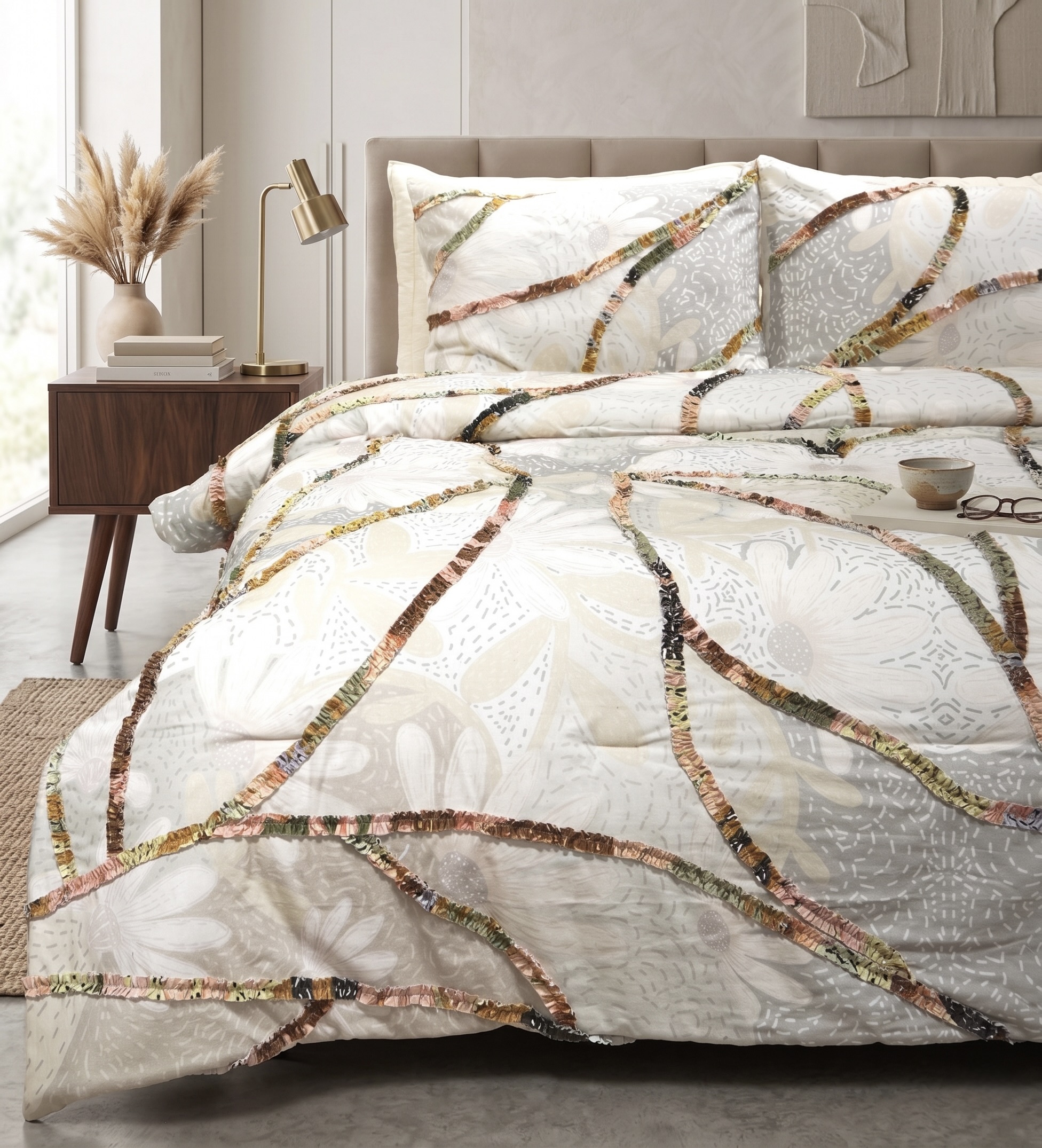
Appliqué gives a comforter real depth. Shaped pieces of fabric are cut and sewn onto the face, so the design is built from cloth rather than ink. Our Mosaic Appliqué Comforter is a cream cotton comforter with diagonal arcs of mosaic style appliqué, with terracotta, sage, ochre and ivory fabric pieces sewn into curved bands. It can be made in custom colors.
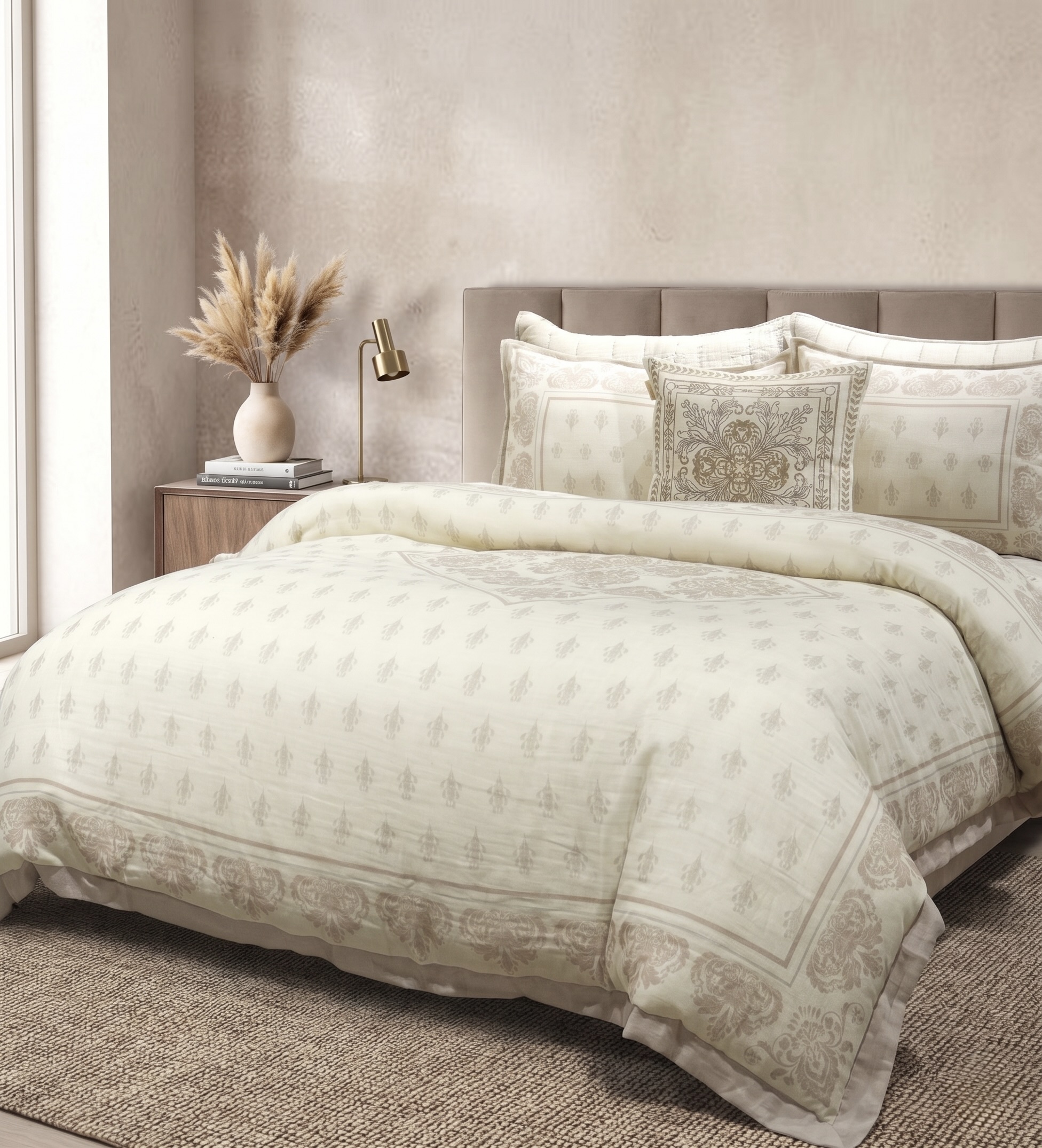
A printed set is the classic route for a matched look across every piece. Our Medallion Print Comforter Set is ivory cotton printed with a repeat fleur de lis and medallion pattern in warm taupe and gold, with a border framing the set. It is supplied with matching shams that carry the full medallion artwork. Agree the repeat, border placement and sham artwork before strike offs begin. Our article on dyeing and printing home textiles covers the methods and their trade offs.
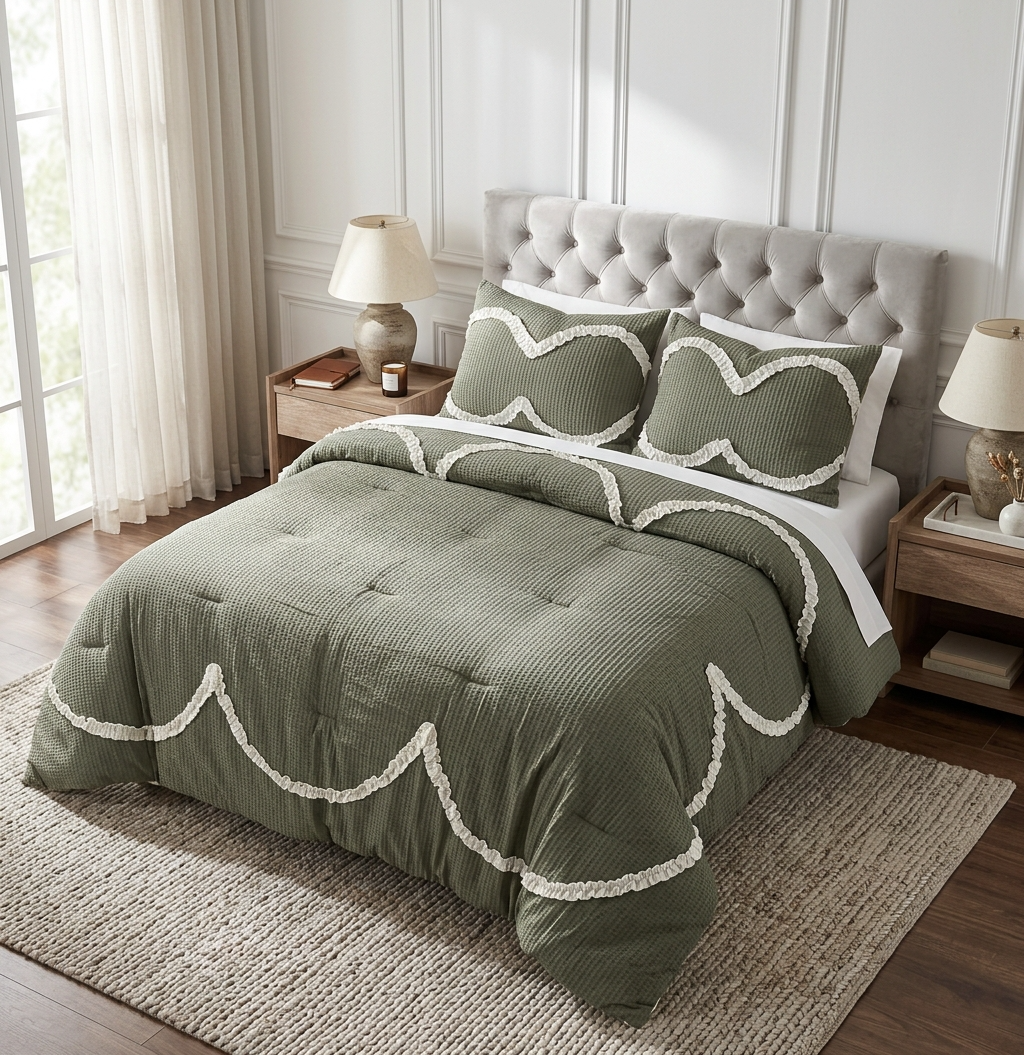
Texture lets a solid color comforter earn its place without a print. Our Olive Textured Comforter is a deep olive green comforter with a textured tonal surface. The muted, earthy tone works with terracotta, ochre or cream cushions, and it suits lifestyle retail and boutique hotel programs. If you plan embroidery or handwork on the face, our guide to specifying embroidery and handwork lists what to define.
Specifying the fill
The fill decides how a comforter feels, how warm it is and how it survives the wash, yet buyers often leave it vague. A brief that says "standard fill" hands the most important decision to chance.
Write the fill down as a specification:
- Fiber. Name it exactly: polyester fiber fill, recycled polyester fill, cotton wadding or a down and feather blend. If you want a recycled claim on the label, the fill has to come through a certified chain as well as the shell.
- Fill weight. State it as a weight per area for each size, rather than words like light, medium or warm. Those words mean different things in different factories, while a number means the same thing everywhere.
- Tolerance. Agree how far the fill weight may vary from the agreed figure, and how it will be checked during production.
- Warmth by market. A lighter fill suits warm climates and all season retail. A heavier fill suits colder markets.
Our filling guide for retailers explains how fill types behave and why the ratio and quality matter, and the same thinking applies to comforters.
Stitching, edges and finishing
Without stitching, fill drifts to the edges after a few washes. Agree the stitch pattern with the design, because on a comforter the quilting lines are visible and become part of the look. Channel lines, boxes and pattern stitching that follows the print each give a different finish. Hand quilting and machine quilting are both possible in our factory, so a buyer can choose a handworked hero piece or a repeatable machine stitched program.
Edges deserve their own line in the tech pack. Decide whether you want a plain stitched edge, a piped edge, a flange or a border. On shams, agree the flange width and the closure. On the approval sample, check corners, thread color, stitch tension and loose ends, since those small details are the first things a returns desk sees.
Sizing for each market
Comforter sizes are not the same from one market or one retailer to the next. A US queen comforter, a UK double and an EU size are different pieces, and two US retailers may also use different measurements for the same size name. Deeper mattresses also need more drop at the sides.
Give the factory the finished dimensions you want for every size, measured flat, along with the allowed tolerance. Ask how size is checked after washing. Sham sizes should be listed the same way. We make bedding in standard and custom dimensions, so the sizing can follow your vendor manual rather than a generic chart.
US labels and customs
US federal rules treat comforters as bedding. The definition of "beddings" in 16 CFR 303.1 names comforters alongside sheets, quilts and bedspreads. The FTC explains in its guide to textile labeling that a covered product needs fiber content by generic name and percentage, country of origin, and the identity of the responsible company, which can be a company name or a registered identification number.
Comforters have one extra point. Under 16 CFR 303.22, when a filling is used for warmth rather than for structure, its fiber content must be stated separately on the label. Some states also regulate filled bedding. In California, for example, the Bureau of Household Goods and Services oversees the bedding industry, so ask your compliance team whether your comforter needs a state label before the artwork is finalized.
For customs, your broker confirms the tariff line in the current Harmonized Tariff Schedule from the finished product, its shell fiber and its fill. Our guide to packaging and labeling for export covers law labels, care labels, barcodes and carton marks in more detail.
Certifications and what to verify
Abhi Home® holds BCI, GOTS, OEKO-TEX and GRS certifications, and each comforter style on our bedding page is listed with OEKO-TEX. OEKO-TEX STANDARD 100 tests every thread, button and accessory of a product for harmful substances, and certificates can be checked online. For a comforter that means the shell, the fill, the thread and the trims all need to fall inside the certificate scope.
Ask three questions of any certificate: does it cover the product type, does it cover every component, and is it valid on the shipment date. For an organic claim, every step from fiber to finished product needs GOTS certification, which is explained on our GOTS certification page. For a recycled claim on the fill or shell, the chain needs GRS certification. Our comparison of OEKO-TEX, GOTS and GRS sets out what each one proves.
Sampling, testing and packing
A comforter set usually goes through three approval stages. First, lab dips or strike offs approve the color and print on the shell fabric. Second, a counter sample shows the full construction, fill and stitching. Third, a pre-production sample is made from bulk materials and sent to the buyer's distribution center or nominated test lab before bulk release. Our article on lab dips, strike offs and pre-production samples explains each step.
Testing for a filled product should cover more than color. Ask for washing results on the whole comforter, including how the fill behaves, how the stitching holds and whether the shell shrinks or pills. Our guide to home textile quality control covers inspection.
Comforters are bulky, so agree whether the set ships in a zip bag, a printed carton or a compressed pack, how the shams sit inside, and how many sets go in each carton. All packaging is made to the buyer's specification, with your brand on the bag.
How to choose a wholesale comforter set manufacturer
Price per set only means something when every supplier quotes the same specification. Compare the whole program:
- Fabric and fill control. Can the manufacturer hold your shell fabric and fill weight across reorders?
- Decoration in house. Printing, dyeing, embroidery, quilting, making up and quality checks under one roof mean fewer hand offs.
- Labeling knowledge. The factory should understand separate shell and fill labeling.
- Private label discipline. We work only under the buyer's brand, care label, tech pack and packaging specification, and we do not compete with our buyers at retail.
- Flexible MOQs. Ask how minimums work per color, per size and per set. Our article on how MOQs work explains the factors.
- Contracting options. US buyers can contract through Abhi Home Inc., our US entity, while production stays made in India. See our bedding program for US buyers.
Our private label development guide walks through the full process from brief to bulk, and our page on bedding manufacturing in India describes our capabilities.
Frequently asked questions
What is usually included in a comforter set?
Most comforter sets include a comforter and one or two matching shams. Some add a bed skirt, decorative cushions or sheets. There is no fixed standard, so list every piece with its size and fabric in your brief.
What is the difference between a comforter and a duvet?
A comforter is a finished filled piece sewn closed and used without a cover. A duvet is a filled insert that normally sits inside a removable duvet cover. In some markets the words are used loosely, so confirm the construction with your supplier.
Does the fill need to be on the label in the US?
Yes, when the fill is there for warmth. Under 16 CFR 303.22, the fiber content of a filling used for warmth is stated separately from the shell. The label also needs country of origin and the responsible company's name or registered number.
Can Abhi Home® make comforter sets under our brand?
Yes. We make comforters and comforter sets as OEM / private label production under the buyer's brand, care label, tech pack and packaging specification, in standard or custom sizes, with flexible MOQs. Send your brief through our contact page to request a quote.
Send your comforter set brief
If you are planning a wholesale comforter set program, send me the basics: the pieces in the set, sizes, shell fabric, decoration, fill fiber and weight, stitching, color references, certifications, labels, packing and your planned delivery window. Browse our bedding range to see current comforter, quilt, duvet cover and coverlet styles. When you are ready, contact our team to request a quote and we will come back with a sampling plan.
Planning a private label comforter set range?
Send us your set contents, sizes, shell fabric, fill and destination, and we will come back with sampling options.
Send your brief →