A duvet cover looks like the simplest product on the bed: two panels of fabric, a closure and a few seams. Buyers who source wholesale duvet covers learn quickly that the details decide whether a program sells and reorders, or comes back as returns. I am Abhijat Paliwal, and at Abhi Home® we have made home textiles in India since 1965. We make duvet covers and duvet cover sets as OEM / private label production under the buyer's brand. This guide explains what a retailer, importer or hospitality buyer should specify, test and ask before placing a wholesale duvet cover order.
Wholesale duvet covers: a private label sourcing guide
What buyers mean by a duvet cover
A duvet cover is a removable case for a duvet or comforter insert. It protects the insert, carries the color and pattern of the bed, and comes off for washing while the insert stays clean. In the trade you will also hear "quilt cover" in the UK, Australia and New Zealand, and some US buyers say "comforter cover". They all describe the same product: a top panel, a back panel and a closure along one end.
Most wholesale programs sell the cover as a set with matching pillowcases or shams. Decide early whether you are buying a cover alone, a cover with two shams, or a full bed set with sheets, because each choice changes the fabric yield, the packaging and the price.
Fabrics and weaves for wholesale duvet covers
The fabric is the largest part of the cost and the first thing a shopper touches. We make duvet covers in cotton percale, cotton sateen and linen, as well as cotton linen blends, organic cotton, recycled cotton blends, and soft muslin and voile cotton for lighter styles. Each base suits a different customer:
- Percale is a plain weave with a crisp, matte, cool hand. It suits hotels and shoppers who like a fresh, pressed bed.
- Sateen floats more yarn on the face, so it has a smooth hand and a soft sheen. It drapes well and reads as premium in store.
- Linen and cotton linen blends give a relaxed, textured look that is popular in lifestyle retail.
- Muslin and voile are light and airy, often washed for a lived in finish.
- Organic and recycled cotton serve programs with a sustainability claim on the label, backed by certification.
Thread count is the number buyers ask about most, yet it is only one part of the story. Yarn quality, weave and finish change the hand as much as the count does. Our bed linen fabric guide explains thread count, fabric weight and weaves in more depth. In your brief, name the base fabric, weave, count and weight you want, then judge the strike off with your own hands rather than by the number alone.
Surface design: solids, prints, pintuck and tufting
Once the base is chosen, the surface is where a range earns its place on the shelf. In our factory a duvet cover can be piece dyed or yarn dyed, block printed, screen printed or digitally printed, and finished with hand embroidery, multi-head machine embroidery, pintuck, dobby, jacquard, ribbon or lace trims.
Texture lets a solid cover stand out without a print. Pintuck is a good example: narrow folds of fabric are stitched across the panel, which gives a ribbed surface that catches the light. Our Terracotta Pintuck Duvet Cover uses an all-over horizontal pintuck stripe on deep rust cotton, and it can be made as a set in custom colors.

Raised tufting is a bolder option for design-led ranges. Yarn is worked into the cover to form a raised motif on the face. Our Sage Botanical Tufted Duvet Cover carries large tonal palm and leaf motifs in raised tufting on sage green cotton, and it is one of the pieces lifestyle buyers ask about most often.
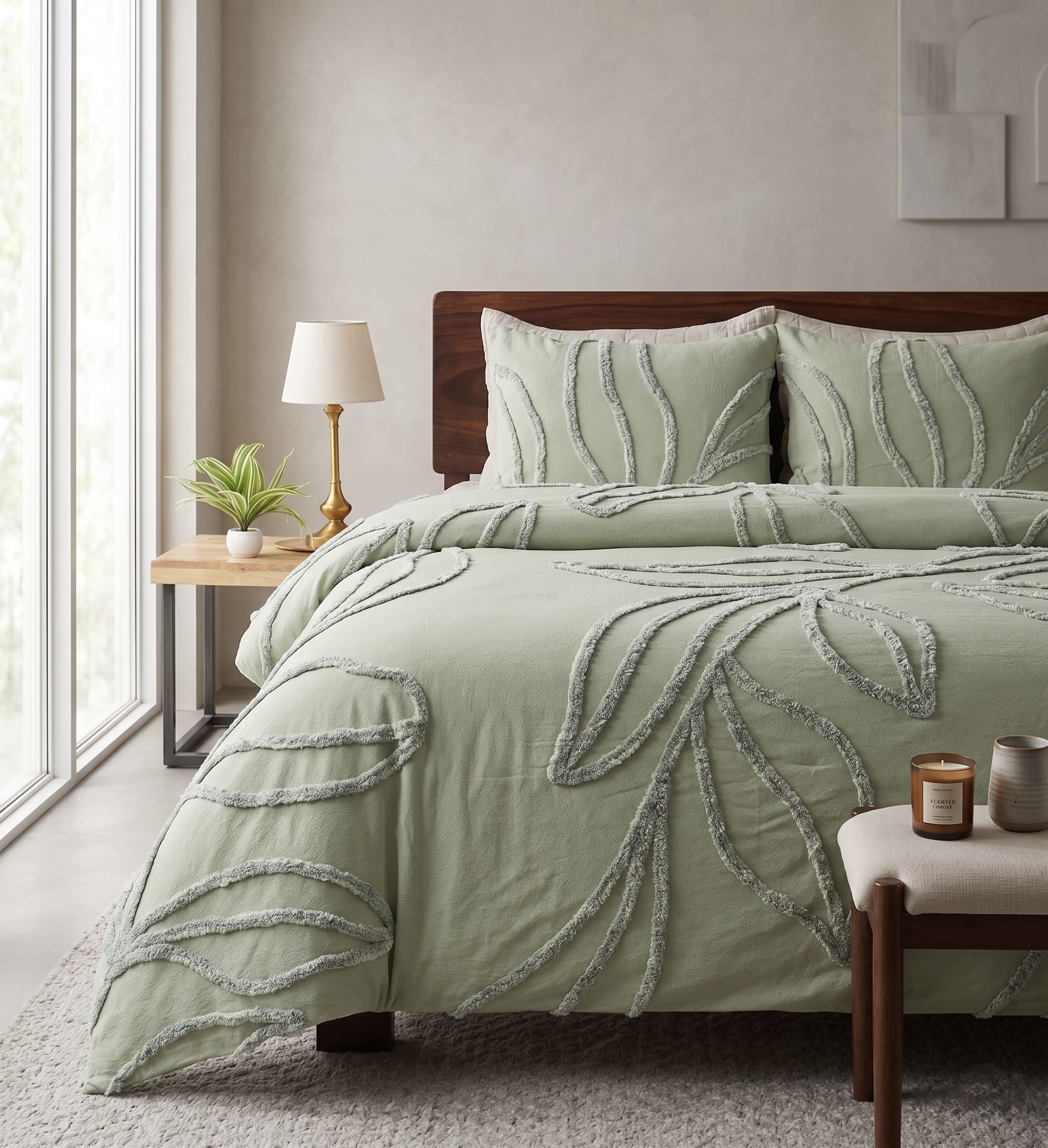
Decoration adds labor and risk, so specify it carefully. Tell the factory how embroidery or tufting should behave in the wash, whether the back of the work will be lined, and how much variation you accept in hand work. For prints, ask how color is matched and approved before bulk. Our guides to dyeing and printing and embroidery and handwork list the points to put in writing.
Closures, ties and inside details
The closure is the detail customers notice every time they change the bed, and it is a common source of complaints. We make duvet covers with button or zip closures, and the right choice depends on your customer:
- Buttons give a classic, quiet finish and are easy to repair. Specify the button material, size and the number of buttonholes, and ask for buttons that survive repeated washing.
- Zips are quick to use and keep the insert in place. Ask for the zip to be hidden under a placket so it does not catch skin or fabric, and specify a zip that can be washed and ironed near.
- Envelope or hidden flap closures have no hardware at all, which some hospitality buyers prefer for fast room turns.
Look inside the cover as well. Corner ties or loops hold the insert in place and stop it bunching at the foot of the bed. Seam type, stitch density and the finish on raw edges decide how the cover lasts. Write each of these into the specification so that every bulk lot matches the approved sample.
Sizing for each market
Bed sizes are not global. The US uses Twin, Full or Queen, King and California King. The UK uses Single, Double, King and Super King. Continental Europe, Australia and the Gulf each have their own conventions. That is why a size name alone is not a specification.
Give the manufacturer finished dimensions for every size, plus the size of the insert the cover must fit. Decide how much ease you want around the insert, because a tight cover strains the closure and a loose one looks untidy on the bed. Allow for shrinkage in the cutting size, since a cover cut to the exact finished size will come out small after the first wash. We make duvet covers in standard and custom dimensions, so a buyer can match an existing insert program or a hotel's own bed specification.
Wash testing, shrinkage and color
A duvet cover is washed far more often than the insert inside it, so laundry performance decides customer reviews. Agree the wash method that matches your customer: a home washing machine for retail, or commercial laundry for hotels. Then ask for test results on dimensional stability, color fastness to washing and rubbing, and pilling, with the method and the pass level written into the order.
Color continuity matters for any program that reorders. A shopper who buys a second cover months later expects it to match the first. We match shades to a buyer's color standard through lab dips and approve the dye lot before bulk. Our quality control guide explains in-line checks and final inspection, so you know which defects are caught on the line and which are caught before shipment.
US labels and customs
If you sell duvet covers in the United States, the textile labeling rules apply. The federal rules under the Textile Fiber Products Identification Act define beddings to include sheets, covers, blankets, comforters, quilts and bedspreads (16 CFR 303.1). The FTC's labeling guide explains that covered products must show fiber content, country of origin, and the identity of the company responsible, which can be its name or a registered identification number (FTC, Threading Your Way Through the Labeling Requirements).
Care instructions are a separate question. The FTC care labeling rule is written for textile wearing apparel and certain piece goods (16 CFR Part 423), yet most retailers still require a clear care label on bedding in their own vendor manuals. Put the full label content, position and language in your brief. For customs, your broker confirms the correct line in the current Harmonized Tariff Schedule, where fiber content and decoration can change the classification. Our packaging and labeling guide covers care labels, swing tags and carton marks.
Certifications and what to verify
Duvet covers sit against the skin for hours every night, so many buyers ask for product safety testing. OEKO-TEX STANDARD 100 tests every thread, button and accessory against a list of harmful substances (OEKO-TEX). At Abhi Home® we hold OEKO-TEX, GOTS, GRS and BCI certifications. GOTS supports organic cotton claims, GRS supports recycled content claims, and BCI covers cotton sourced through that program.
A certificate only helps when its scope covers your product. Check the certificate number in the certifier's online database, confirm that duvet covers or bed linen are inside the scope, and ask for transaction documents for GOTS or GRS shipments when you print an organic or recycled claim on the label. Our explainer on OEKO-TEX, GOTS and GRS shows what each one covers, and our GOTS certified page explains how we handle organic programs.
Sampling, approvals and packing
Good programs are built in the sampling stage, not on the shipping date. The usual sequence is a lab dip or strike off for color and print, a counter sample of the cover in the agreed fabric and construction, and a pre-production sample from bulk materials. We send pre-production samples to the buyer's office, distribution center or nominated test lab before bulk is released. Approve each stage in writing so that the approved sample becomes the standard for inspection.
Packing is part of the product. Decide whether each cover ships folded in a bag, in a printed card wrap, in a zip bag with an insert card, or as a set packed together. Our guide to lab dips, strike offs and pre-production samples explains each approval step.
How to choose a wholesale duvet cover manufacturer
Price per piece is easy to compare and easy to misread. A useful supplier comparison looks at the whole program:
- Fabric control. Can the manufacturer develop and hold your base fabric across reorders, or does it buy whatever is available that season?
- Decoration in house. Printing, dyeing, embroidery and making up under one compliance scope reduce hand-offs and quality gaps.
- Testing and documents. Ask for recent wash test reports and certificates whose scope covers bed linen.
- Private label discipline. The factory should work under your care label, tech pack and packaging spec, and should not sell your designs to anyone else.
- Flexible MOQs. Ask how minimums work per color, per size and per set, and whether sampling quantities are lower. Our article on how MOQs work explains the factors.
- Contracting options. US buyers can contract through Abhi Home Inc., our US entity, while production stays made in India. See our bedding program for US buyers.
Request quotes on the same specification from each supplier so the numbers are comparable. Our private label development guide walks through the full process from brief to bulk.
Frequently asked questions
What is the difference between a duvet cover and a comforter?
A duvet cover is a removable shell that slips over a separate insert and closes with buttons, a zip or a flap. A comforter is a finished filled piece sewn closed around its fill. Many retailers sell both, and a duvet cover can be sized to fit a comforter insert.
Which fabric is best for wholesale duvet covers?
It depends on the customer. Percale gives a crisp, cool hand that suits hotels and classic retail. Sateen feels smooth with a soft sheen. Linen and cotton linen blends give a relaxed, textured look. Approve the fabric on a strike off rather than by thread count alone.
What labels does a duvet cover need in the US?
Under the FTC textile rules, a duvet cover sold in the US needs fiber content, country of origin and the identity of the responsible company, which can be a name or registered identification number. Most retailers also require care instructions under their own vendor manuals.
Can Abhi Home® make duvet covers under our brand?
Yes. We make duvet covers and sets as OEM / private label production under the buyer's brand, care label, tech pack and packaging specification, in standard or custom sizes, with flexible MOQs. Send your brief through our contact page to request a quote.
Send your duvet cover brief
If you are planning a wholesale duvet cover program, send me the basics: the fabric and weave you want, sizes and insert dimensions, closure, decoration, color references, certifications, labels, packing and target delivery window. Browse our bedding range to see current duvet cover, quilt and coverlet styles, and read about our bedding manufacturing in India. When you are ready, contact our team to request a quote and we will come back with a sampling plan.
Planning a private label duvet cover range?
Send us your sizes, fabric, closure, design and destination, and we will come back with sampling options.
Send your brief →