Wholesale bedding is rarely one product. A bedroom program usually covers sheets, pillowcases, duvet covers, quilts, coverlets and comforters, and every piece has to match in color, finish and quality from the first delivery to the last reorder. I am Abhijat Paliwal, and at Abhi Home® we have made home textiles in India since 1965. We make bedding as OEM / private label production under the buyer's brand, for retailers, importers and hospitality groups. This guide explains how I would plan a wholesale bedding range, what to specify for each category, and what to check before you place a bulk order.
Wholesale bedding: how to plan a private label range
What counts as wholesale bedding
Buyers use the word bedding loosely, so it helps to start with a clear definition. US textile labeling rules define beddings in 16 CFR 303.1 as sheets, covers, blankets, comforters, pillows, pillowcases, quilts, bedspreads, pads and other textile products used on or about a bed. Furniture, mattresses and box springs are excluded.
That definition is useful for two reasons. It tells you which products need a textile fiber label in the US, and it gives you a checklist for the range. In our factory the bedding categories we make are flat sheets, fitted sheets and pillowcases, duvet covers and duvet cover sets, quilts, coverlets and bedspreads, comforters, decorative bedding, baby and kids bedding in GOTS organic cotton, and hospitality bedding such as duvet covers and encasements for hotel supply. Decorative cushion and pillow covers often sit beside these, and our wholesale pillow covers guide covers them separately.
Plan the range before you ask for quotes
A bedding range works best when it is built in layers. The foundation is the basics: sheets, pillowcases and duvet covers, usually in solid colors that reorder season after season. The second layer is the top of bed: quilts, coverlets and comforters that carry the design story. The third layer is the accent pieces: shams, cushions and throws that add color and lift the average order.
Write down three things for every layer before you contact a supplier:
- The role of the product. Is it a repeat basic, a seasonal design or a hero piece for photography?
- The color story. Which shades must match across categories, and which can contrast?
- The channel. Retail shelf, online, catalog or hotel rooms each change the packaging, the labeling and the testing.
A plan like this lets a manufacturer quote the whole program, share fabric between products and suggest where one base cloth can serve several items.
Sheets, pillowcases and duvet covers
Sheets and pillowcases are the highest volume part of most bedding programs, and they are where consistency matters most. A shopper who buys a fitted sheet today expects the replacement next year to be the same shade, the same hand feel and the same fit. Specify the base cloth, the weave, the finish, the hem style and the fitted sheet pocket depth and elastic in writing. Our bed linen fabric guide explains percale, sateen, linen, thread count and fabric weight in detail.
Duvet covers carry more design. We make them in cotton, from textured solids to tufted botanical designs, with a button or zip closure, in standard and custom dimensions. Decide the closure early, because it changes the cost, the packing and the care instructions.
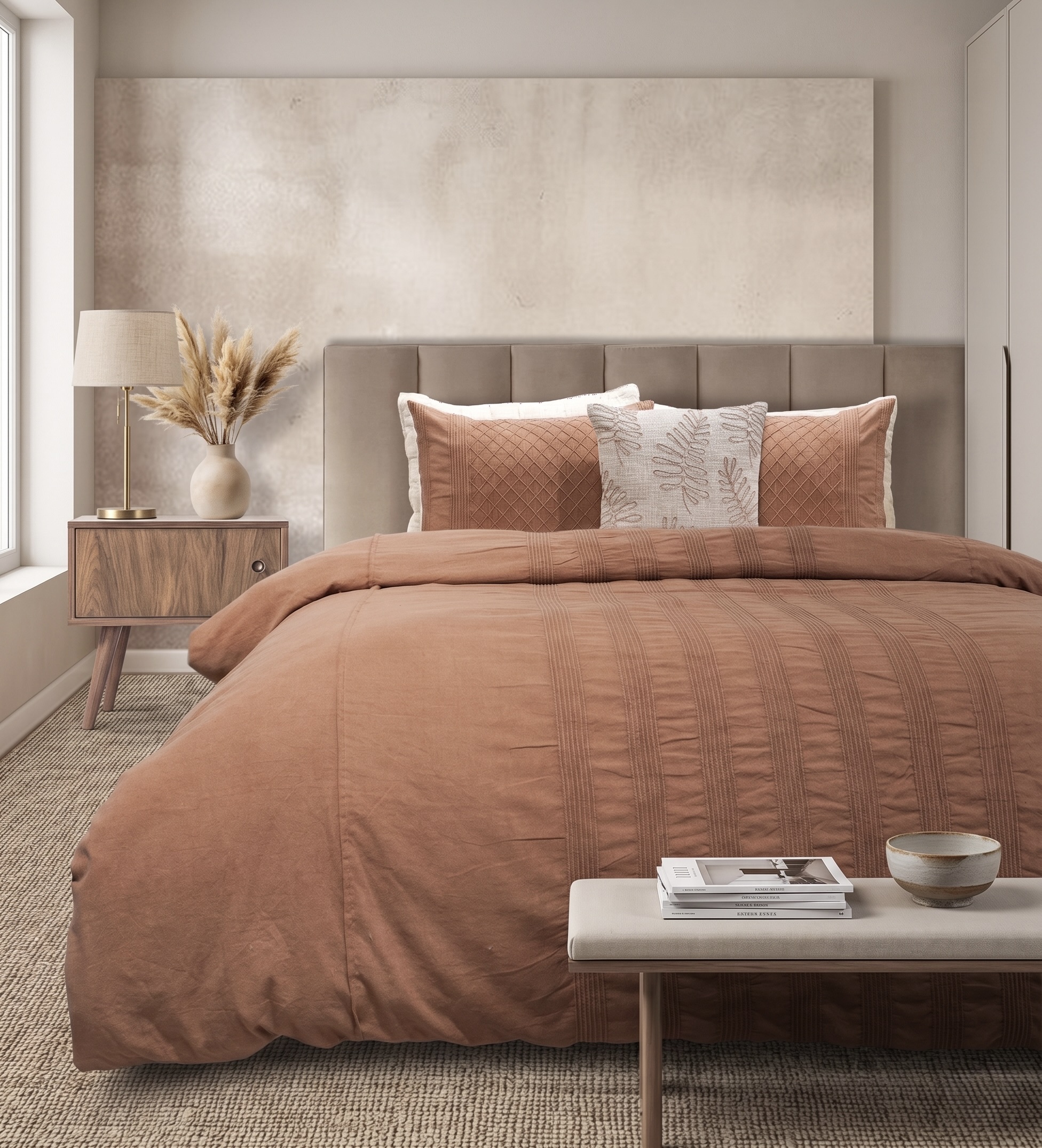
Texture is one of the easiest ways to lift a basic duvet cover above the commodity level. Our Terracotta Pintuck Duvet Cover is deep terracotta rust cotton with an all over horizontal pintuck stripe. It pairs with botanical and embroidered cushions, and it is available as a set in custom colorways.
Quilts, coverlets and bedspreads
Quilts and coverlets are where Indian craft shows most clearly. We make quilts in cotton and linen, including hand stitched kantha and patchwork constructions, in standard and oversized dimensions. A quilt is three layers stitched through, so the stitching pattern, the fill and the edge finish all need to be agreed at sampling.
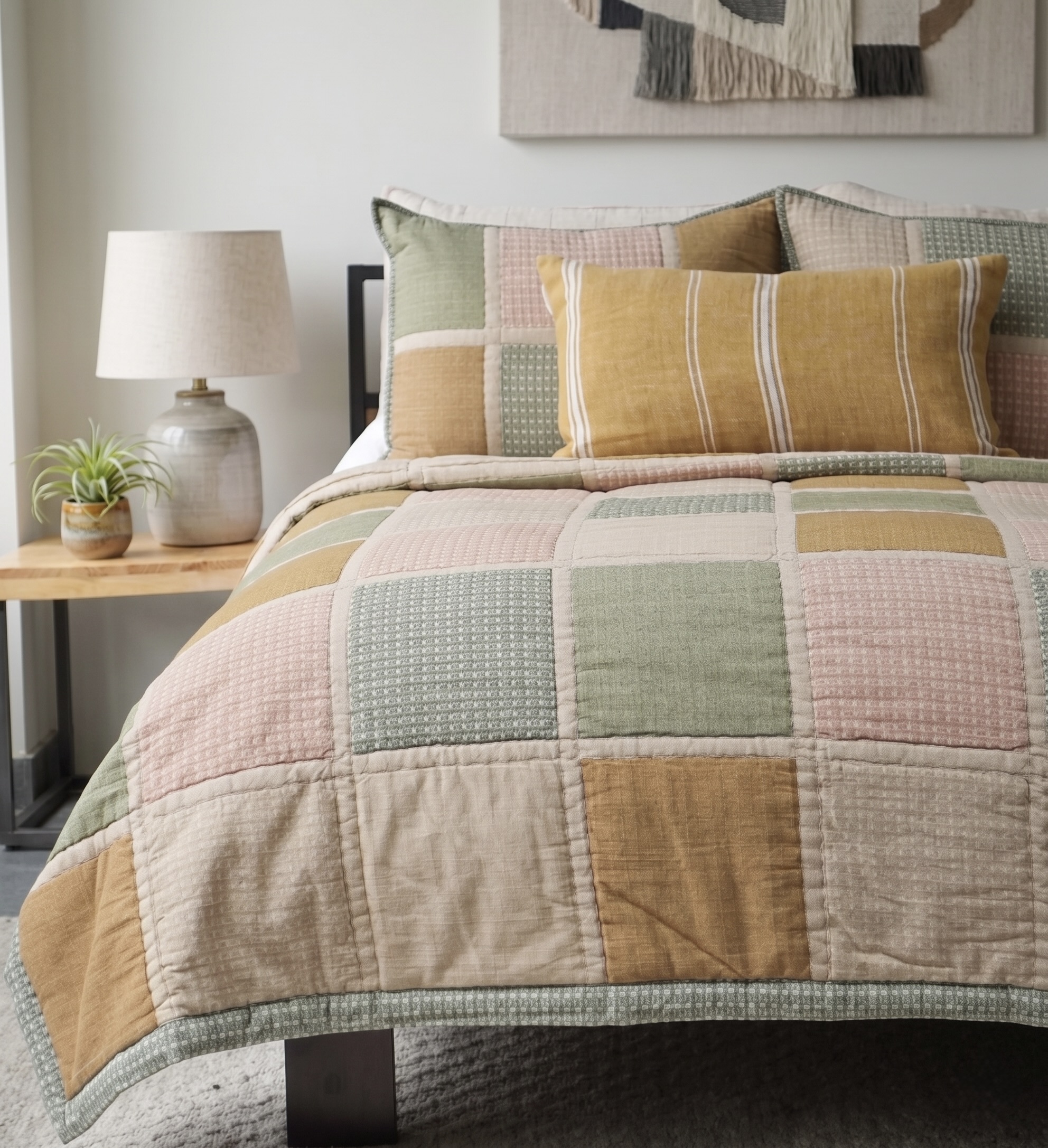
Patchwork is a good example of a design that needs a clear specification. Our Heritage Patchwork Quilt is made from blush pink, sage green, mustard and natural linen blocks, each block in a different surface texture from dotted to plain to stripe, and it is supplied with matching quilted shams. For a design like this, approve the block layout and every fabric in the patchwork, not just the overall color.
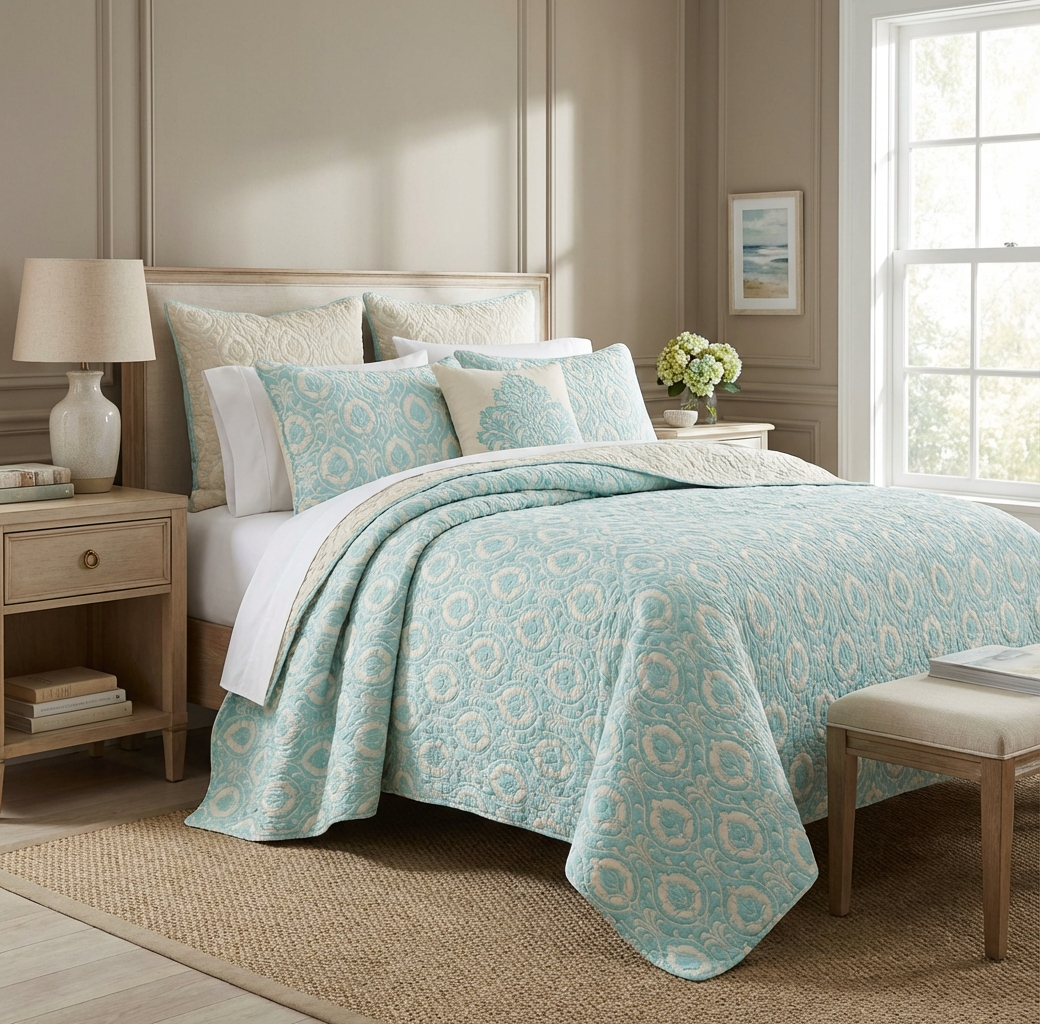
Coverlets and bedspreads are lighter and layer well over a duvet or on their own in warm climates. We make them in cotton, including seersucker and matelassé constructions, in custom dimensions and colorways. Our Turquoise Matelasse Coverlet has a raised jacquard weave surface and a decorative border, light enough to layer and substantial enough to use alone.
For more on fills, stitching and sizes, read our quilt and bedspread buying guide and our wholesale quilts guide, or browse the quilt collection.
Comforters and coordinated sets
A comforter is a finished filled piece sewn closed around its fill and used without a cover, so its face is the product the shopper sees. We make comforters in printed cotton, appliqué and textured constructions, filled and finished for retail, and each design pairs with our cushion and coverlet ranges for complete bedroom programs.
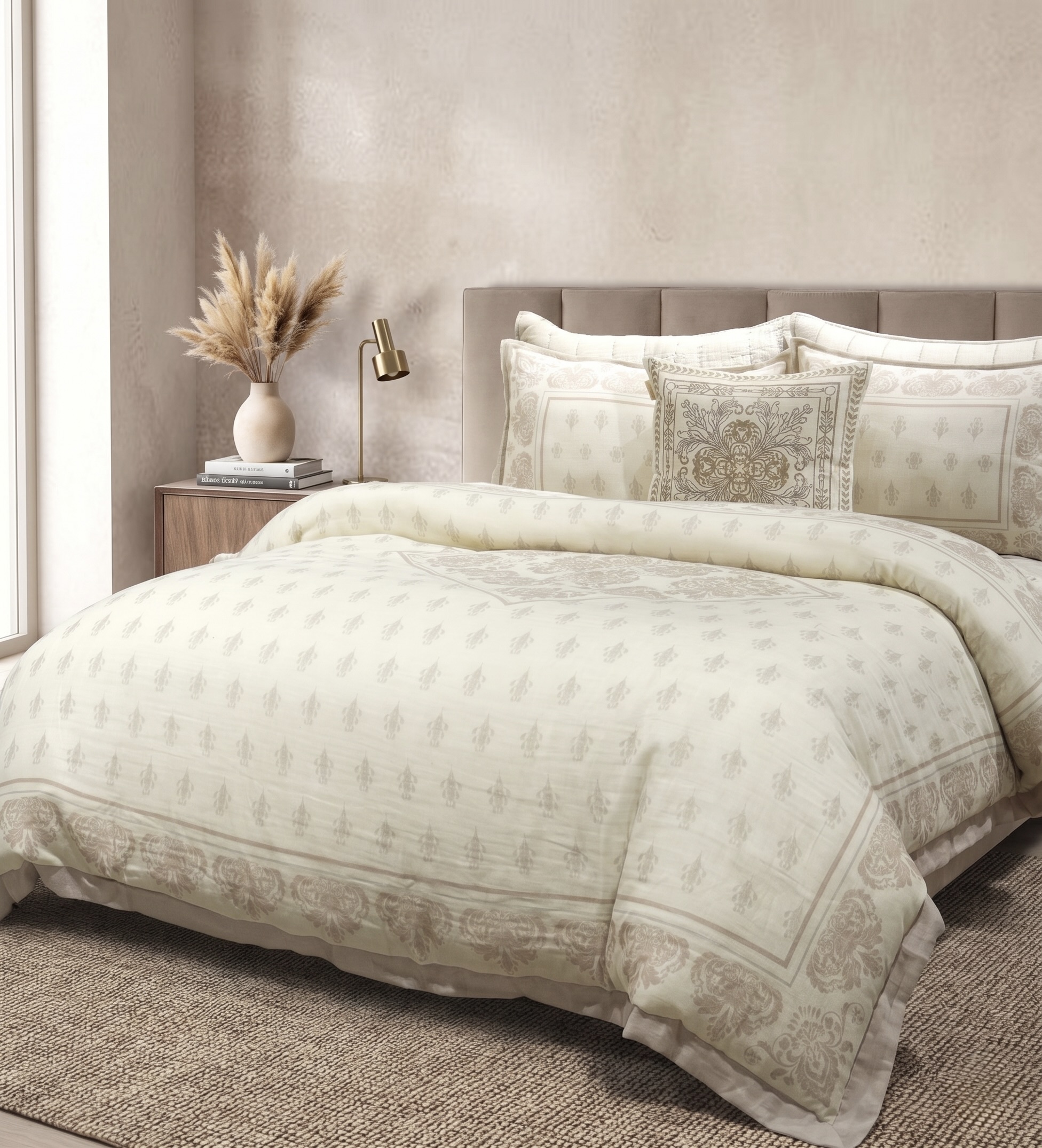
Sets need a written component list. Our Medallion Print Comforter Set is ivory cotton printed with a repeat fleur de lis and medallion pattern in warm taupe and gold, with a border framing the set, and it is supplied with matching shams carrying the full medallion artwork. For a printed set, approve the repeat, the border placement and how the artwork sits on each sham before bulk printing starts.
If the comforter has a fill used for warmth, its fiber content has to be specified and labeled as well as the shell.
Fabric, color and decoration
Most of the cost and most of the quality risk in bedding sit in the fabric. For bedding we work in cotton percale, cotton sateen, cotton linen blends, linen and linen percale, organic cotton (GOTS), recycled cotton blends (GRS), and muslin and voile cotton.
Once the base is chosen, decide how it will be colored and decorated. A bedding program can be piece dyed or yarn dyed, block printed, screen printed or digitally printed, and finished with hand embroidery, multi head machine embroidery, hand or machine quilting, pintuck, dobby, jacquard, ribbon or lace trims. Each route has its own approval step: lab dips for dyed shades, strike offs for prints and a sample for embroidery. Our guides to dyeing and printing and embroidery and handwork explain what to specify for each.
Color is where a coordinated range succeeds or fails. Give one physical or Pantone reference per shade and ask for every fabric in that shade to be matched to the same standard, under the same light source.
Sizing for each market
Bed sizes are not universal. A queen in the US, a double in the UK and a standard size in Europe or Australia are different, and pillow formats differ too.
Never rely on a size name alone. Put the finished dimensions of every product in the tech pack, state whether they are measured before or after washing, and agree a measuring method and tolerance. For fitted sheets, give the mattress depth the sheet must fit. All of our bedding is made in standard and custom dimensions, so the starting point is always the buyer's size chart.
US labels and country of origin
For the US market, bedding is a textile product covered by the textile labeling rules. The FTC guide Threading Your Way Through the Labeling Requirements lists bedding, including sheets, covers, comforters, pillowcases, quilts and bedspreads, and explains that labels must show fiber content, country of origin and the identity of the manufacturer or another responsible business. Fiber content uses generic fiber names and percentages by weight in order of predominance, and the business can be identified by company name or a registered identification number (RN).
For our products the country of origin is made in India. Send your label artwork and placement with the tech pack, and approve the printed label on the pre production sample. Our packaging and labeling guide covers the practical side, and your customs broker should confirm the classification for each product.
Certifications and what to verify
Abhi Home® holds OEKO-TEX, GOTS, GRS and BCI certifications. Each answers a different question. OEKO-TEX STANDARD 100 is a harmful substances test; according to OEKO-TEX, every thread, button and accessory of a certified article is tested, and bed linen falls into the product class for items with direct skin contact. GOTS covers organic fiber through processing, and GRS covers recycled content through the chain of custody.
Three checks protect a certified bedding program. First, confirm that the certificate scope covers the actual product and process, not just the fabric. Second, check the certificate number yourself; OEKO-TEX certificates can be checked in its online Label Check. Third, for an organic or recycled claim on the label, make sure transaction documents follow the goods. Our article OEKO-TEX vs GOTS vs GRS explains the differences, and our GOTS certification page covers organic programs.
Sampling, quality control and packing
Bedding sampling normally runs in stages. A counter sample confirms the construction and the look. Lab dips and strike offs confirm color and print. A pre production sample, made from bulk fabric with final labels and packaging, is the sample that bulk is checked against, and we send pre production samples to the buyer's distribution center or nominated test lab before bulk release. Our guide to sampling, lab dips and strike offs explains each step.
Wash the whole finished piece, not only a fabric swatch, and check shrinkage, color fastness, seam strength and the look after washing. During production, inline and final inspections check measurements, stitching, shade and packing against the approved sample. Our article on home textile quality control sets out what a good inspection plan covers.
Packing is part of the product. Agree the retail format, whether that is a printed bag, a box, a ribbon wrap or bulk packing for hotels, along with the inserts, barcodes and the number of pieces in each carton.
How to choose a wholesale bedding manufacturer
Price per piece only means something when every supplier quotes the same specification. When you compare bedding manufacturers, look at the whole program:
- Range across categories. One partner for sheets, duvet covers, quilts, coverlets and comforters makes color matching across the range far easier.
- Processes in house. Fabric development, dyeing, printing, embroidery, making up and quality checks under one roof mean fewer hand offs and clearer accountability.
- Private label discipline. We work only under the buyer's brand, care label, tech pack and packaging specification, and we do not compete with our buyers at retail.
- Flexible MOQs. Ask how minimums work per color, per size and per design. Our article on how MOQs work explains the factors.
- Contracting options. US buyers can contract through Abhi Home Inc., our US entity, while production stays made in India. See our bedding program for US buyers.
Our private label development guide walks through the process from brief to bulk, and our page on bedding manufacturing in India describes our capabilities.
Frequently asked questions
What products are included in wholesale bedding?
Wholesale bedding usually covers sheets, pillowcases, duvet covers, quilts, coverlets, bedspreads and comforters, often with shams and decorative cushions. US labeling rules define beddings to include sheets, covers, blankets, comforters, pillows, pillowcases, quilts, bedspreads and pads.
Can I source a whole bedding range from one manufacturer?
Yes. At Abhi Home® we make sheets, pillowcases, duvet covers, quilts, coverlets, bedspreads and comforters, so color, fabric and finish can be coordinated across the range from one production base.
What must a US bedding label show?
A US textile label for bedding shows fiber content by generic name and percentage, the country of origin and the identity of the responsible company by name or RN. Care, size and brand details are added to the buyer's specification.
Can Abhi Home® make bedding under our brand?
Yes. We make bedding as OEM / private label production under the buyer's brand, care label, tech pack and packaging specification, in standard or custom sizes, with flexible MOQs. Send your brief through our contact page to request a quote.
Send your bedding brief
If you are planning a wholesale bedding program, send me the basics: the products and sizes in the range, base fabrics, colors and references, decoration, fills for quilts and comforters, certifications, labels, packing and your planned delivery window. Browse our bedding range to see current quilt, duvet cover, coverlet and comforter styles. When you are ready, contact our team to request a quote and we will come back with a sampling plan.
Planning a private label bedding range?
Send us your categories, sizes, fabrics and destination, and we will come back with sampling options.
Send your brief →