Buyers who search for wholesale chenille bath rugs usually already know the look they want: a soft, velvety rug that customers reach out and touch in the store. The harder questions come next. Is it cotton or synthetic, will the pile survive the laundry, which backing goes underneath, and can the factory make a matching set? I am Abhijat Paliwal, and at Abhi Home® we have made home textiles in India since 1965. We make chenille bath rugs in 100% cotton, only as OEM / private label production under the buyer's brand. This guide covers what to know and what to specify before you place a wholesale chenille order.
Wholesale chenille bath rugs: a private label guide
What chenille is, and why buyers ask for it
Chenille is a yarn before it is a rug. Short lengths of yarn, the pile, are held between two core yarns and twisted together, so the pile stands out all around the core. The name comes from the French word for caterpillar, which is exactly what a strand of chenille yarn looks like up close.
Built into a bath rug, those yarns create a deep, rounded surface that feels softer than a standard cut pile. A chenille bath rug sells on touch, and in cotton it also soaks up water from wet feet.
The same structure explains the main risk. The pile is held only by the twist of the core yarns, so yarn quality decides whether the rug keeps its pile through washing. A poor chenille goes bald in patches, and that complaint turns into returns.
Cotton chenille or synthetic chenille
Chenille describes how the yarn is built, not what it is made of. Many chenille bath mats on the market are polyester or microfiber chenille rather than cotton, so state the fiber in the brief and check it on the sample and the label.
We make our chenille bath rugs in 100% cotton chenille yarn. For a buyer, cotton chenille offers three practical things:
- Absorbency. Cotton takes up water, which is what a customer expects from a bath rug used straight out of the shower.
- A clear fiber story. A pile face in 100% cotton can be stated simply on the label and in product copy.
- Certification routes. Cotton yarn can be built into organic or recycled content programmes, which matters if your range carries those claims.
The trade off is that a dense cotton pile holds water, so it needs time and airflow to dry. That is worth noting in your care copy.
Chenille next to tufted and woven bath mats
Most buyers mix two or three constructions into one bath range, so it helps to know where chenille sits.
Tufted bath mats are made by punching yarn into a base cloth to form the pile. Tufting can be cut, loop, a combination of both, or carved, so the pattern is carried by the pile itself. A tufted mat can be single-sided with an anti-skid backing, or reversible with two finished faces and no backing. Tufting is where most patterned and sculpted designs live. See our tufted cotton bath mats for the range.
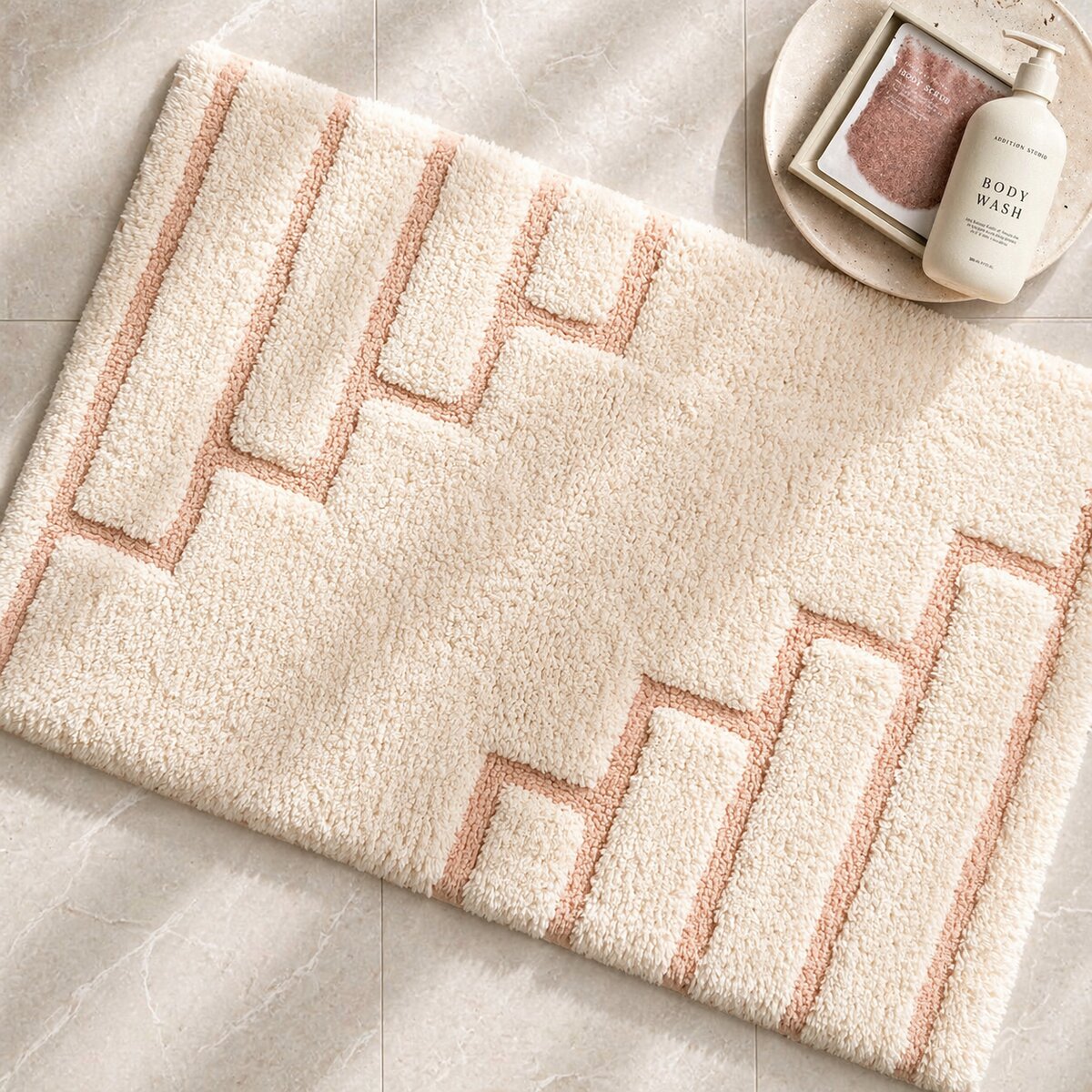
Woven bath mats are made in one piece on the loom, with the texture built into the cloth. There is no pile to shed, they dry faster, and they feel flatter and less plush. Woven mats are normally single-sided and take a backing. They suit settings with heavy laundering. Browse our woven bath mats to compare.
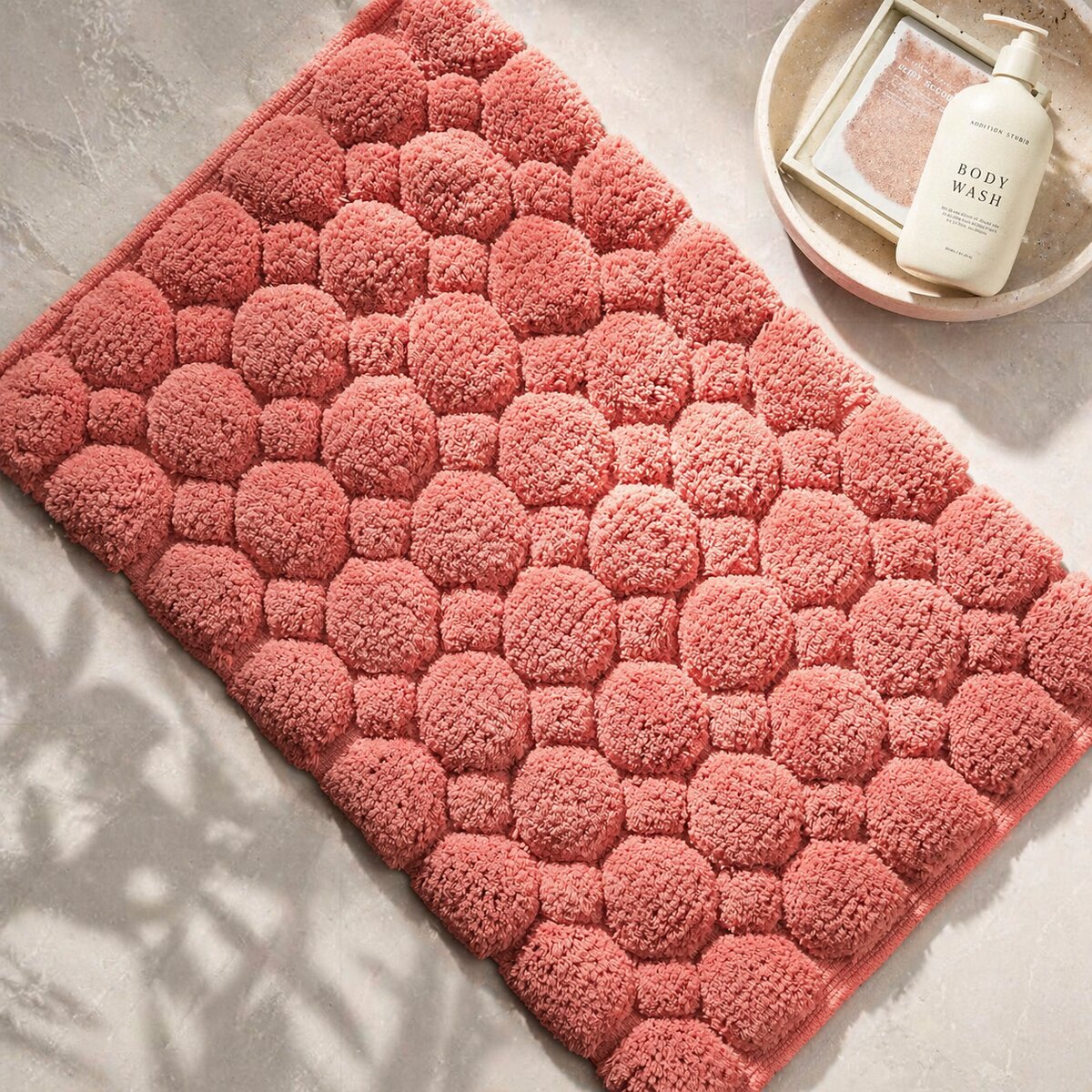
Chenille bath rugs sit at the plush end of the range. They give the softest hand and the most luxurious look, they come finished with an anti-skid backing (or unbacked on request), and they need the most care in yarn selection and wash testing. If your customer wants two usable faces, choose a reversible cotton bath mat instead; a backed chenille rug has one face.
What to put in a chenille bath rug brief
A clear brief gets you to an approved sample faster. These are the points I confirm with every chenille buyer before we sample:
- Fiber. State 100% cotton chenille yarn, or the organic or recycled content you need, so the yarn is bought to match.
- Pile height and weight. These decide how plush the rug feels and what it costs. We sample against a target that you set, not a guess.
- Color. Send a Pantone reference or a physical swatch. For sets, all pieces are produced together so they match.
- Size and format. Single rug, set or runner, with your market sizes. We confirm which sizes run most efficiently.
- Backing. Latex, spray latex, hot melt or TPR rubber, chosen for how the rug will be washed and used.
- Edge finish. Bound or overlocked, with the binding color matched or contrasted. Scalloped and custom shapes are possible on request.
- Wash targets. Shrinkage, colorfastness and pile security after washing, written into the tech pack so the sample is tested against them.
- Labels and packaging. Your brand label, care label, fiber content line, country of origin and retail packaging.
If you have a reference rug, send it; matching a physical sample is faster than describing a hand feel. For a wider view of how we take a bath brief, see our guide on how to specify a cotton bath mat programme.
Choosing the anti-skid backing
Every chenille bath rug we make can carry the backing your programme needs. We confirm the backing in writing at sampling, then wash test it on the approved sample so grip and adhesion are proven before bulk.
- Latex, full coat. A continuous latex coat locks the pile in and gives the firmest grip on tile. It is our standard backing. Latex has a heat limit, so it suits gentle home washing and low or line drying, not hot tumble drying.
- Spray latex. A lighter, sprayed layer. The rug stays softer and more flexible, with good grip for everyday home use.
- Hot melt. A thermoplastic adhesive applied hot, usually as a dot or line pattern. It grips the floor while leaving part of the back open.
- TPR rubber. Thermoplastic rubber, generally more flexible than latex and more durable through repeated machine washing. It is the usual choice when the rug will be washed often.
For chenille, the backing keeps the rug from sliding, and a full coat also helps hold the base of the pile. So I always ask how your customer will wash and dry the rug before I recommend one.
Single rugs, sets and runners
Chenille works in every bath rug format we make:
- Single bath rugs in your market sizes.
- Contour rugs shaped to sit around the base of a toilet.
- Two and three piece sets, combining a rug, a contour rug and a lid cover, or two rugs in different sizes.
- Mat and runner sets, and runners and large bath rugs made to any length and width.
Sets need one extra discipline: every piece must come from the same dye lot and run, or the colors drift apart on the shelf. We produce set pieces together for that reason. Our guide to wholesale bathroom rug sets covers set planning in more detail, and you can see set formats on our bath rug sets page.
Sampling and wash testing
For chenille, the sample is where most problems are caught or missed. Our sequence is simple:
- Counter sample. We make a sample against your brief or reference, in your color, pile target and backing.
- Wash test. We wash the sample and check pile security, shrinkage, colorfastness and backing adhesion against the targets in your tech pack.
- Your approval. You test the sample yourself or at your lab, and approve in writing, including any comments.
- Pre-production sample. Before bulk, a sample from production materials confirms the approved standard can be repeated.
Any new pile rug can release some loose fiber in its first washes; what matters is that the pile stays locked in. For the full sampling stages, see our guide to lab dips, strike offs and PP samples, and our explainer on home textile quality control.
US labels, flammability and certificates
If you sell into the United States, these points come up on almost every chenille programme. This is general information, not legal advice.
Flammability. The federal standard for small carpets and rugs, 16 CFR Part 1631, defines a small carpet or rug as a floor covering with no dimension greater than 6 feet and an area not greater than 24 square feet. Most bath rugs fall inside that definition, so ask your supplier how the test is handled for your sizes.
Fiber content on floor coverings. Under 16 CFR 303.11, a floor covering with an exempted backing discloses fiber content for the face or pile only, with wording such as "100% Cotton Pile". That suits a cotton chenille rug with a latex or TPR back.
What the label must show. 16 CFR 303.16 requires generic fiber names and percentages, the name or registered identification number of a responsible company, and the country of origin. For our chenille rugs, that country is India.
Certificates. Abhi Home® holds BCI, GOTS, OEKO-TEX and GRS certifications, and ISO 9001:2015. For chenille bath rugs, OEKO-TEX Standard 100 is our default; under that standard every component of the certified article is tested against a list of harmful substances. For organic cotton programmes we work to GOTS, and for recycled content to GRS, with the transaction certificate supplied with the shipment. Which certificate applies depends on the yarn, so we confirm it in writing at sampling. You can check our OEKO-TEX certification details on our site.
How a wholesale chenille order runs
From brief to container, a chenille programme follows the same path as our other bath products: brief, quote, counter sample and wash test, your approval, then yarn bought to the approved standard, set pieces produced together, and goods checked, labeled and packed to your instructions before they ship from India.
We work to flexible MOQs, so small first orders are welcome; the right quantity depends on your colors, sizes and backing, so request a quote against your actual brief. For buyers who prefer to contract in the United States, our US trading company, Abhi Home Inc., can handle the contract while the goods ship direct from India. Our guide to bath mat MOQs, lead times and sampling and our checklist for importing bath rugs from India cover the commercial side in more depth.
Questions to ask before you shortlist
These questions separate a capable chenille manufacturer from a trading desk:
- Is the chenille yarn 100% cotton, and will the label and certificate say so?
- Which backing do you recommend for how my customer washes, and will you wash test it on my sample?
- How do you check pile security, and what happens if the bulk does not match the approved sample?
- Can you produce sets from one dye lot?
- Which certificates apply to this yarn, and will a transaction certificate travel with the shipment where needed?
Get the answers in writing. Our guide on how to choose a wholesale bath mat supplier goes further on vetting.
Frequently asked questions
Are your chenille bath rugs 100% cotton?
Yes. They are made in India from 100% cotton chenille yarn, which gives the plush, velvety surface and the absorbency buyers expect from a cotton bath rug.
Does a chenille bath rug shed?
Any new pile rug can release some loose fiber in its first washes. What matters is that the pile stays locked in, so we check pile security on the sample and again after a wash test, before bulk is approved.
Which backing suits a chenille bath rug that is washed often?
TPR rubber is generally more flexible than latex and more durable through repeated machine washing. Latex gives the firmest grip but does not suit hot tumble drying. We confirm the backing at sampling and wash test it.
Can chenille bath rugs be made as sets or runners?
Yes. Chenille works as a single rug, as a two or three piece set with a contour rug and lid cover, as a two-size set, or as a runner or large rug in any size.
Does Abhi Home® make chenille bath rugs under our brand?
Yes. Abhi Home® works only as an OEM / private label manufacturer, so every rug carries your brand, your labels and your packaging. We work to flexible MOQs; request a quote against your brief.
Send your chenille bath rug brief
If you are planning a wholesale chenille bath rug or bath mat range, tell me the sizes, colors, backing, certificates and target price you have in mind. We will come back with a counter sample plan and a quote. You can request a quote on our contact page, or start with our 100% cotton chenille bath rugs and the wider cotton bath rugs range.
Building a private label bath mat range?
Send us your sizes, construction, backing and destination, and we will come back with sampling options.
Send your brief →