When a buyer searches for a cotton bath mats manufacturer, they usually want to know two things: can this factory make the mat I have in mind, and will the thousandth piece look like the approved sample? I am Abhijat Paliwal, and at Abhi Home® we have made home textiles in India since 1965. Bath mats and bath rugs are the heart of our bath programme, and we make them only as OEM / private label production under the buyer's brand. This guide walks through how a cotton bath mat is actually made, where each construction fits, and what to check before you trust a manufacturer with your range.
Cotton bath mats manufacturer: how we make them in India
What a cotton bath mat manufacturer does
A manufacturer is the business that turns cotton yarn into a finished, labeled, packed bath mat, and a buyer should know who controls each step.
In our case, every mat is made in India: tufting, weaving, finishing and quality checks run in our own facility, and we ship under our own export documentation. That gives a buyer one point of accountability from the first counter sample to the container. For buyers who prefer to contract and invoice in the United States, our US trading company, Abhi Home Inc., handles the contract while the goods ship direct from India. Both routes are explained on our bath mat manufacturing in India page and our US bath textile page.
What a good manufacturer adds is judgement. The brief decides the construction, the size, the weight and the backing, and part of my job is to tell a buyer when the construction they asked for will not do the job they described.
It starts with the cotton yarn
Our standard bath mats and bath rugs are 100% cotton, and for tufted mats we use ring-spun cotton yarn as standard. Cotton is the fiber buyers ask us for most in bath mats, because it absorbs water well and has a natural hand that synthetic fibers try to imitate.
The fiber choice is also where your certification story starts. We can run bath programmes in GOTS certified organic cotton, GRS recycled content or BCI cotton, and OEKO-TEX® Standard 100 is our default for bath. Which certificate applies depends on the yarn, so we confirm it in writing at sampling. If organic is your angle, our organic bath mats page and our GOTS certification page explain how that chain works.
Tufted cotton bath mats
Tufting is the construction most of our retail customers come to us for. The machine punches cotton yarn through a backing cloth to build a pile, and the pile is then locked in place. That pile is what gives a tufted cotton bath mat its depth, its absorbency and its recovery underfoot. Because the pattern is carried by the pile itself rather than by print, a tufted bath rug holds its look through repeated washing far better than a printed flat surface.
Within tufting there are several routes. Cut and loop gives a two-level texture. Combo tufting mixes cut and looped areas in the same mat. Carved or embossed tufting sculpts the pile after tufting to create relief, which is how geometric lines and brick grids appear without a single extra color. Each route gives a different hand, a different price point and a different look on the shelf, so I would choose the route before choosing the colorways.
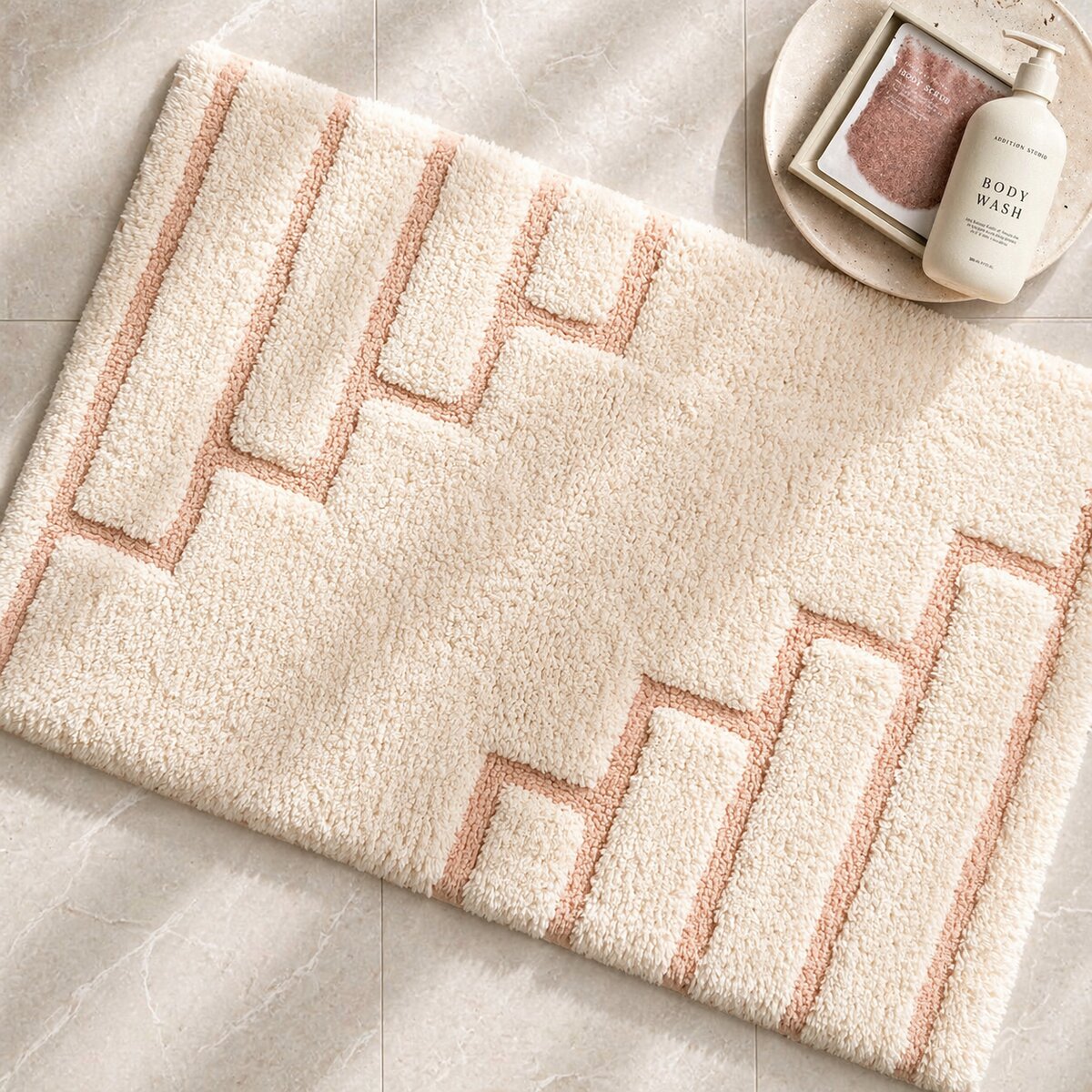
One point buyers often miss: a tufted mat can be made single-sided or reversible. Single-sided is the usual choice, and it takes an anti-skid backing. The reversible version is covered further down.
Woven cotton bath mats
A woven bath mat is made in one piece on the loom. The pebble, bubble or ribbed relief is built into the structure of the cloth rather than punched into a backing, so there is no inserted pile to shed and the texture cannot pull out in the wash. The raised surface lets air through, which helps the mat dry between uses instead of staying damp.
Woven and tufted get used as if they mean the same thing in the trade, and they should not be. What a woven mat gives up is plushness. A woven relief will never feel as deep underfoot as a heavy tufted pile, and I would rather say that plainly than see a buyer specify the wrong construction. Where laundering frequency matters, such as rentals, serviced apartments, hospitality and family bathrooms, woven is often the right answer. Where the story is underfoot comfort, tufted usually is.
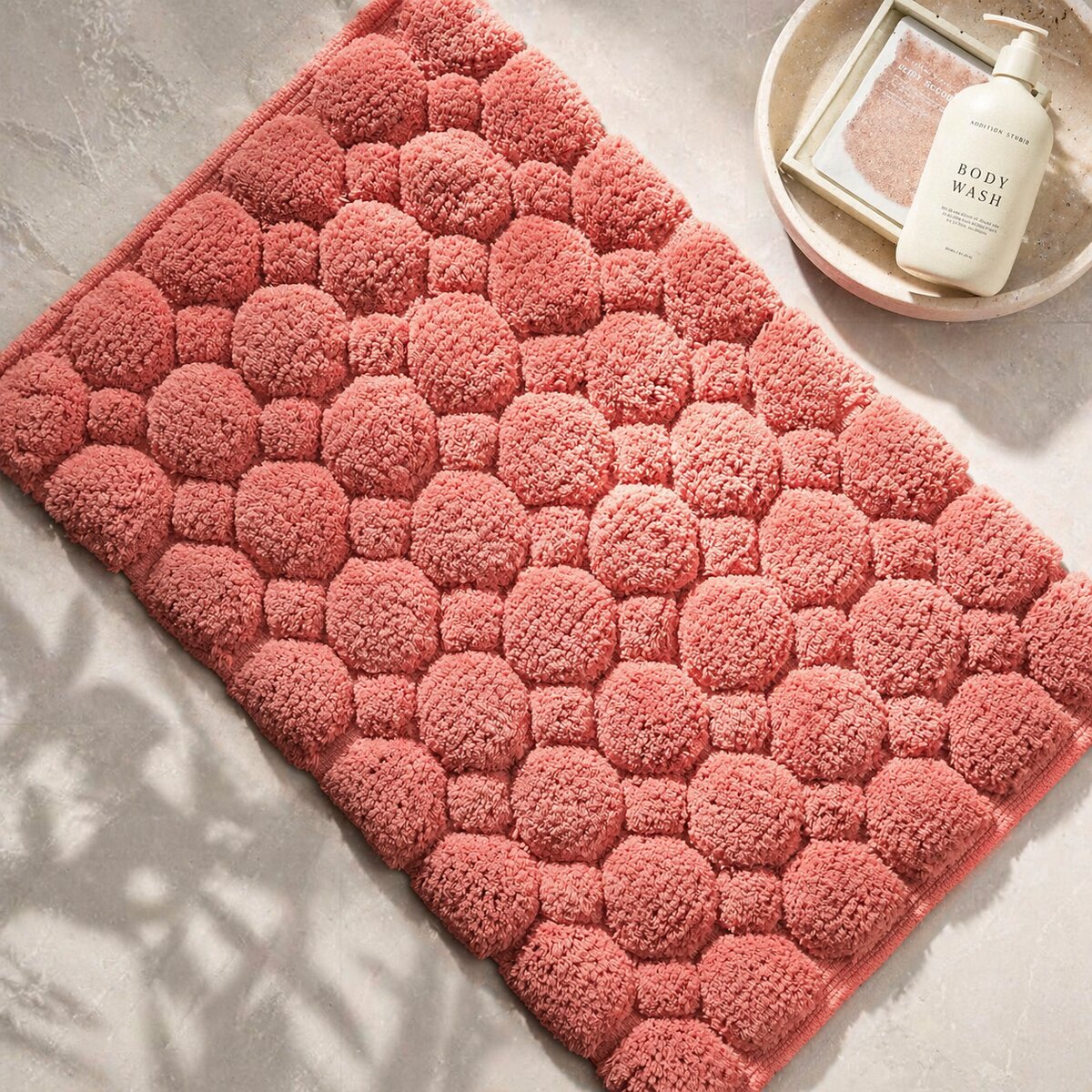
Woven mats are normally single-sided, so they take an anti-skid backing in the same way as a single-sided tufted mat.
Reversible cotton bath mats
A reversible cotton bath mat has no wrong side. Both faces carry the pattern and both are finished to the same standard, so the end customer can turn it over between washes. For a retailer that is a durability story that fits easily on a swing ticket. Tufting is the easiest way to make a mat like this.
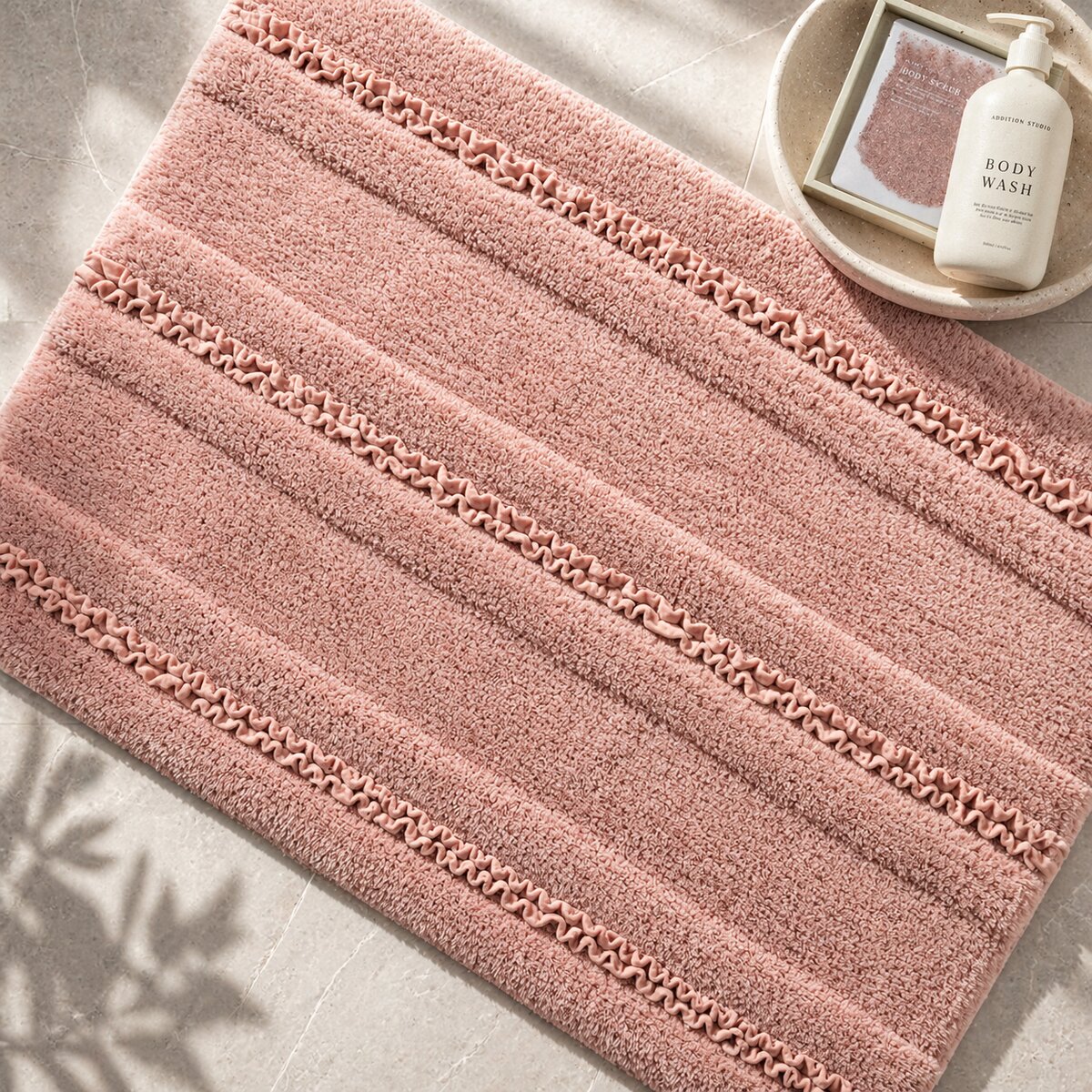
The trade-off is grip. Because both faces are used, a reversible mat cannot take any anti-skid backing. If your market or your customer has a strict non-slip requirement, choose the single-sided version of the same design instead.
Quick-dry waffle bath rugs
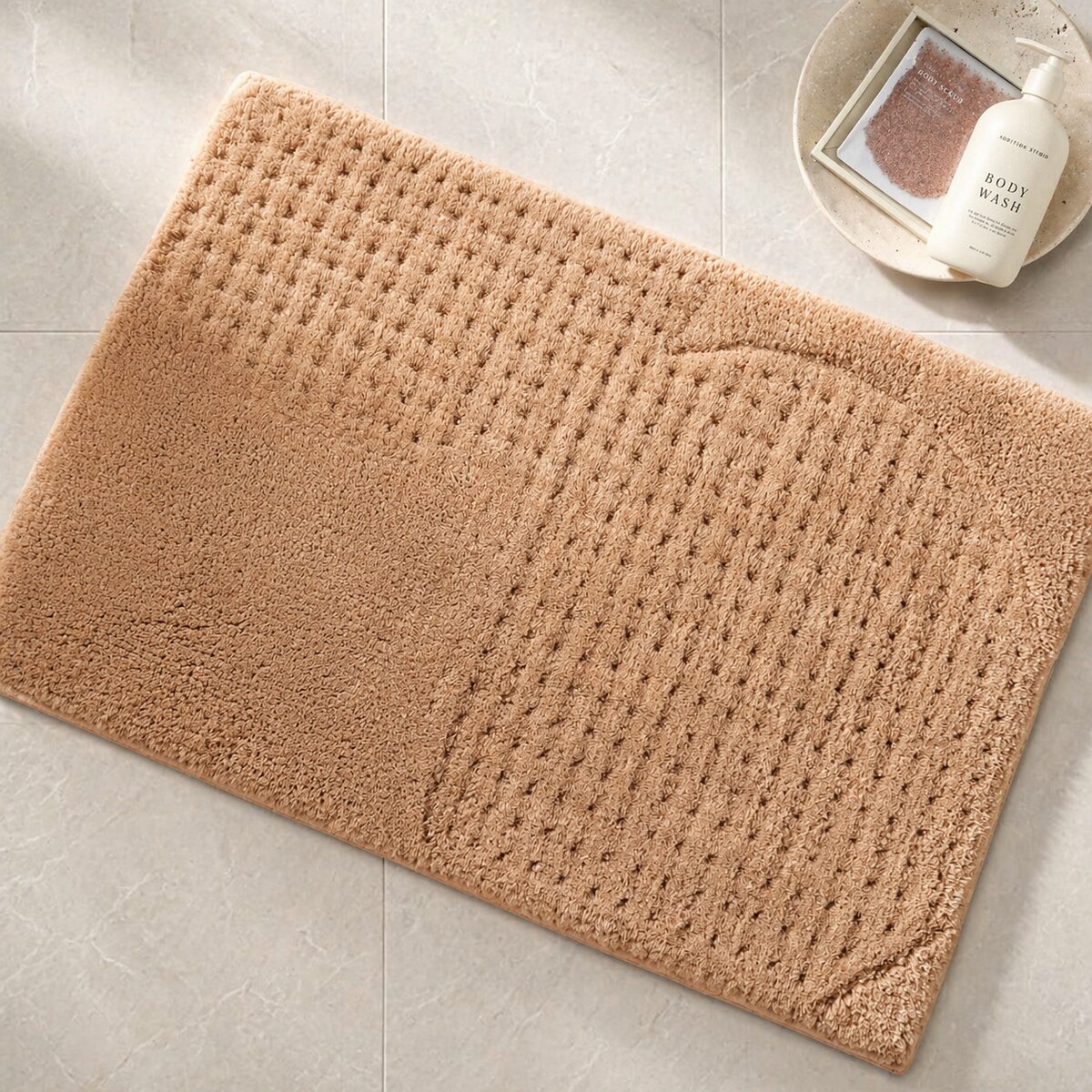
Some programmes are built around drying speed rather than plushness, typically for humid markets, holiday lets and rentals. A quick-dry waffle structure takes up and releases water faster than a standard pile, because the open waffle pattern lets air reach more of the surface. It is a useful second construction alongside a plush tufted core line, giving the shopper a clear choice between comfort and practicality.
Anti-skid backing on single-sided mats
Every single-sided cotton bath mat, tufted or woven, can take an anti-skid backing. We offer four types, and each suits a different use:
- Latex (full coat): our standard. A continuous coat locks the pile in and gives the firmest grip on tile. Latex has a heat limit, so it suits home washing at moderate temperatures and low or line drying, not hot tumble drying.
- Spray latex: a lighter sprayed layer. The mat stays softer and more flexible, with good grip for everyday home use.
- Hot melt: a thermoplastic adhesive applied hot, usually as a dot or line pattern, which grips the floor while leaving part of the back open.
- TPR rubber: thermoplastic rubber, generally more flexible than latex and more durable through repeated machine washing, so it is the usual pick for mats that will be washed often.
Unbacked single-sided mats are also possible on request, and reversible mats are always unbacked. Backing changes both the cost and the care instructions, so we confirm it in writing at sampling and then wash test it on the approved sample. Our guide on how to specify a cotton bath mat programme covers the backing decision in more depth.
Edges, shapes, sets and runners
Finishing is where a mat stops looking like a commodity. We finish edges as bound, overlocked, scalloped or ruffle trimmed, and we cut custom die shapes for ovals, scallops and novelty forms on our shaped bath mats programme.
Most buyers do not stop at a single mat. A cotton bath programme usually grows into coordinated bath rug sets with contour pieces, runners for double vanities and larger rugs made to the buyer's own dimensions. The manufacturing challenge there is matching: every piece in a set must match in color and pile, which is far easier when the same factory makes all of them from the same dye lot. We cover that in detail in our guide to wholesale bathroom rug sets.
Sampling and wash testing before bulk
The sample is where a manufacturer proves it understood your brief. Our usual sequence is a counter sample against your reference, then changes, then an approved sample, then a pre-production sample sent to your distribution center or nominated test lab before bulk is released. Physical samples are sent at our cost. If you already sell a design and want it counter sampled, send a physical piece or a clear photo with dimensions. Where a design is protected by someone else's intellectual property, we will say so and propose a distinct alternative.
When the sample arrives, wash it. Check how the pile recovers, whether the backing stays bonded, how the edges hold and whether the color moves. A sample that only looks right on a desk tells you very little about a bath mat, because a bath mat lives on a wet floor and in a washing machine. Our articles on textile sampling stages and home textile quality control explain what to look for at each stage, and bath mat MOQs, lead times and sampling explains how we plan around your ship window.
US labels, flammability and certificates
For the United States, a cotton bath mat is a textile product and a small rug at the same time, and both sets of rules apply. Three points matter most:
- Flammability: the federal standard for the surface flammability of small carpets and rugs (16 CFR Part 1631) covers floor coverings with no dimension greater than 6 feet and an area of no more than 24 square feet, and it states that mats within those dimensions are included.
- Fiber content on mats with a backing: under the Textile Act rules, when a floor covering has an exempted backing, the fiber disclosure relates only to the face or pile (16 CFR 303.11), which is why you will see wording such as "100% Cotton Pile" on a backed bath rug.
- What the label shows: the required label information (16 CFR 303.16) covers the generic fiber names and percentages by weight, the name or registered identification number of the manufacturer or a business marketing the product, and the country where it was made.
On certificates, OEKO-TEX® Standard 100 tests every thread, button and accessory of a certified article against a list of harmful substances, and a buyer can check any certificate in the OEKO-TEX Label Check. Ask your manufacturer for the certificate number and check its scope yourself. For organic or recycled claims, ask for the transaction certificate with the shipment as well. Our OEKO-TEX page and our importing checklist for bath rugs from India cover the paperwork that travels with each order.
Questions to ask a manufacturer
Whoever you shortlist, these questions separate a cotton bath mat manufacturer from a business that only resells one:
- Which constructions do you tuft or weave in your own facility, and which, if any, are made elsewhere?
- Can you make the same design single-sided with a backing and reversible without one?
- Which backing do you recommend for my washing instructions, and will you wash test it on the approved sample?
- Which certificates do you hold, and can I check the certificate numbers myself?
- Will the transaction certificate travel with the shipment for organic or recycled claims?
- Can every piece of a set or a runner come from the same dye lot?
- Who is my point of contact from sample to shipment, and who signs the export documents?
Our earlier guide on how to choose a wholesale bath mat supplier covers how to compare quotes once you have answers.
Frequently asked questions
Is a cotton bath mat the same as a cotton bath rug?
In practice, yes. Buyers in the United States tend to say bath rug, especially for larger sizes, while the UK, Australia and India usually say bath mat. The brief decides the build: construction, size, weight and backing.
Can a tufted bath mat be reversible?
Yes. A tufted mat can be single-sided with an anti-skid backing, or reversible with two usable faces and no backing. Woven mats are normally single-sided and take a backing.
Which backing is best for frequent washing?
TPR rubber is generally the most durable through repeated machine washing. Latex gives the firmest grip but has a heat limit. Tell us how the mat will be washed and we will recommend a backing and wash test it on the sample.
Does Abhi Home® make cotton bath mats under our brand?
Yes. Abhi Home® works only as an OEM / private label manufacturer, so every mat carries your brand, your care label and your packaging. We work to flexible MOQs, so request a quote against your actual brief.
Send your cotton bath mat brief
If you are planning a cotton bath mat or bath rug programme, tell me the construction, sizes, backing, certifications and volumes you have in mind. We will come back with a sampling plan and a quote. You can request a quote on our contact page, or start by browsing our full range of cotton bath rugs and bath mats, including 100% cotton chenille bath rugs.
Building a private label bath mat range?
Send us your sizes, construction, backing and destination, and we will come back with sampling options.
Send your brief →